
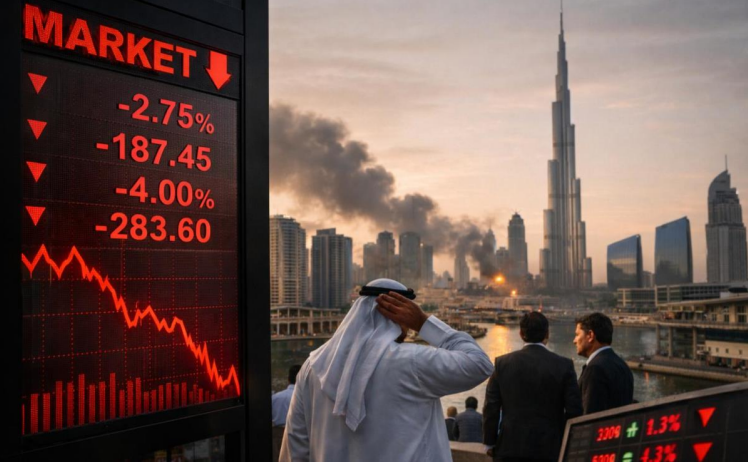
Escalating geopolitical tensions across the Middle East have triggered a wave of volatility in financial markets throughout the Gulf Markets Conflict region, with several major stock exchanges registering sharp declines amid heightened uncertainty. Investors reacted nervously to the widening conflict involving Iran, Israel and the United States, as missile attacks, energy infrastructure disruptions and security risks intensified across the region. Financial analysts note that markets in Dubai, Abu Dhabi, Qatar and other Gulf states have been particularly sensitive to the conflict because of their close integration with regional energy markets and global trade flows.
On Monday, the Dubai Financial Market experienced the steepest losses among Gulf Markets Conflict exchanges, with its main index falling about 2.5 percent, reflecting widespread investor concern about the potential economic consequences of the conflict. Major listed companies also declined sharply, including Emaar Properties, whose shares dropped 4.9 percent, and Emirates NBD, which fell 1.7 percent during the trading session. Since the conflict began, Dubai’s market index has lost more than 18 percent of its value, reducing its overall market capitalisation to approximately $229.6 billion.
Regional Stock Exchanges Reflect Investor Anxiety
Across the Gulf Markets Conflict region, stock markets broadly ended in negative territory as investors reassessed risks associated with the rapidly evolving geopolitical environment. In addition to Dubai’s steep decline, the Abu Dhabi Securities Exchange also slipped, with its benchmark index falling 0.2 percent during the same trading session. The downturn was largely driven by a 3.5 percent drop in Aldar Properties, one of the UAE’s largest real estate developers, highlighting the sensitivity of property and financial sectors to regional instability.
Elsewhere in the region, several other Gulf Markets Conflict recorded notable declines. Qatar’s main index fell around 1.2 percent, while Bahrain’s market dropped 1.8 percent, Oman’s benchmark slipped 0.7 percent, and Kuwait’s index edged down 0.4 percent. Egypt’s benchmark EGX30 index also declined by approximately 1.6 percent, illustrating how the ripple effects of the conflict extended beyond the immediate Gulf states into broader regional markets.
Market analysts say these declines reflect a “risk-off” sentiment among investors who are shifting funds away from equities toward safer assets amid geopolitical uncertainty. Historically, Gulf Markets Conflict have shown resilience due to strong fiscal positions and energy revenues, but episodes of military escalation often trigger temporary sell-offs as traders adjust portfolios to reflect new geopolitical risks.
Impact of the Iran Conflict on Regional Economies
The market downturn is closely linked to the broader economic consequences of the conflict, particularly the disruption of energy production and export routes in the Middle East. Since the outbreak of hostilities, oil output across several Gulf Markets Conflict producers has declined significantly, with regional production falling by at least 10 million barrels per day, representing one of the largest supply disruptions in modern energy market history.
A major factor contributing to the economic uncertainty is the crisis in the Strait of Hormuz, a strategic waterway between Iran and Oman that handles around 18–20 million barrels of oil per day, or roughly one-fifth of global oil consumption. Military threats and attacks on shipping have caused tanker traffic to fall dramatically, with hundreds of vessels avoiding the route due to security concerns.
These disruptions have driven sharp fluctuations in global energy prices and heightened fears of supply shortages. Oil prices surged above $100 per barrel during the crisis, raising concerns about inflation, higher transportation costs and reduced global economic growth. For Gulf Markets Conflict economies, whose fiscal revenues depend heavily on hydrocarbons, the conflict presents both opportunities through higher prices and risks through supply disruptions and market instability.
Corporate Sector and Financial Institutions Under Pressure
The regional conflict has also created significant challenges for major corporations and financial institutions operating in the Gulf Markets Conflict. Several large companies listed on regional exchanges have seen sharp declines in share prices as investors anticipate disruptions to trade, logistics and consumer demand. The steep drop in real estate and banking stocks in Dubai illustrates how sectors tied closely to regional economic growth can be affected by geopolitical shocks.
Financial institutions have responded cautiously to the evolving crisis. Reports indicate that global banking giant Citigroup has closed its offices in the United Arab Emirates as part of precautionary measures, reflecting the growing perception of operational risk in the region. Such developments highlight how geopolitical tensions can affect not only local businesses but also multinational corporations with significant regional exposure.
The volatility has also prompted stock exchanges and regulators to introduce measures aimed at stabilising markets. In previous trading sessions, the Dubai and Abu Dhabi exchanges implemented temporary price limits on securities to prevent excessive market swings following missile and drone attacks linked to the conflict. These safeguards are designed to maintain orderly trading and protect investors during periods of heightened uncertainty.
Global Market Repercussions and Investor Sentiment
The financial turbulence in Gulf Markets Conflict has mirrored broader global market reactions to the Middle East conflict. International stock indices have also experienced volatility, as investors evaluate the potential impact of rising energy prices, supply chain disruptions and geopolitical escalation. Early in the conflict, the Dow Jones Industrial Average fell more than 400 points, while major European and Asian markets also declined amid uncertainty.
Investors have increasingly shifted toward safe-haven assets such as gold and the U.S. dollar during periods of geopolitical instability. Gold prices typically rise during conflicts as traders seek protection against market volatility, while stronger demand for the dollar reflects its status as the world’s primary reserve currency. These shifts in capital flows can intensify pressure on emerging markets, including several Gulf economies.
At the same time, analysts note that financial markets often react sharply in the early stages of geopolitical crises before stabilising once the economic implications become clearer. Some investment strategists argue that while the conflict has triggered short-term volatility, Gulf Markets Conflict could recover if energy exports resume and regional security conditions improve.
Conclusion
The recent decline in Gulf financial markets highlights the profound sensitivity of regional economies to geopolitical developments in the Middle East. As tensions between Iran, Israel and the United States escalate, investors remain wary of the potential economic fallout from disrupted energy supplies, attacks on infrastructure and instability in key shipping routes. These factors have contributed to a broad decline in stock markets across the Gulf Markets Conflict, reflecting uncertainty about the trajectory of the conflict.
Despite the market turbulence, Gulf Markets Conflict economies possess significant financial buffers derived from energy revenues and sovereign wealth funds. These resources provide governments with the capacity to support financial markets and stabilise economic activity if the conflict continues. Additionally, the region’s long-term economic diversification strategies may help mitigate the impact of geopolitical shocks over time.
Looking ahead, the direction of Gulf Markets Conflict will largely depend on the evolution of the regional conflict and the stability of global energy supplies. A de-escalation of hostilities or restoration of secure shipping routes could quickly restore investor confidence. However, if military tensions persist and energy infrastructure remains vulnerable, financial markets across the Gulf may continue to face volatility in the weeks and months ahead.