
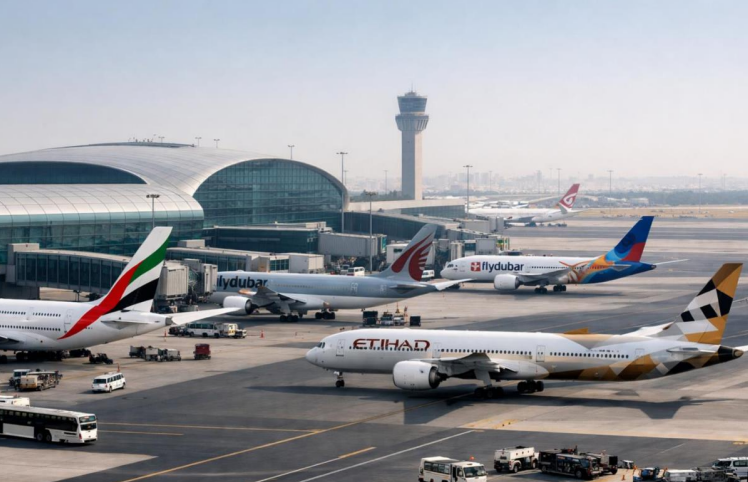
Major Gulf carriers including Emirates, Etihad Airways, Qatar Airways, flydubai and Air Arabia have begun rerouting flights and adjusting schedules to maintain global connectivity after temporary airspace restrictions disrupted travel across parts of the Middle East. The aviation adjustments come as heightened regional tensions forced several countries to close or restrict sections of their airspace, prompting Gulf Airlines to redesign flight paths linking Asia, Europe and North America.
The Gulf region hosts some of the world’s most important aviation hubs, including Dubai International Airport, Hamad International Airport in Doha and Zayed International Airport in Abu Dhabi. These airports act as critical intercontinental transit points, enabling millions of passengers to connect between continents through hub-and-spoke networks operated by the region’s major Gulf Airlines.
As a result, even temporary airspace disruptions have a ripple effect across global aviation networks. Gulf Airlines have responded by rerouting aircraft around restricted zones, introducing limited schedules and prioritising essential long-haul routes to ensure passengers and cargo continue moving through the region’s major hubs.
Strategic Role of Gulf Aviation Hubs
Gulf airlines have built one of the most extensive global aviation networks over the past two decades, transforming cities such as Dubai, Doha and Abu Dhabi into major intercontinental travel hubs. Emirates, Qatar Airways and Etihad Airways together operate fleets of wide-body aircraft connecting hundreds of cities across six continents.
Dubai International Airport has repeatedly ranked among the world’s busiest international passenger airports, handling tens of millions of travellers each year. Meanwhile, Doha’s Hamad International Airport and Abu Dhabi’s Zayed International Airport have expanded rapidly, supporting the growth of Qatar Airways and Etihad Airways as global long-haul carriers.
These hubs are strategically located between East and West, allowing Gulf Airlines to link cities that would otherwise require complex travel itineraries. For example, routes between Europe and Asia, Africa and North America, and South Asia and the Americas often rely on Gulf hubs for efficient connections.
Because of this central position in the global aviation network, disruptions to Middle Eastern airspace can affect airline schedules worldwide. Aviation analysts say maintaining operational continuity in Gulf hubs is therefore essential for the stability of international travel.
Airlines Introduce Limited Schedules and Emergency Flight Corridors
To maintain operations during the airspace disruptions, Gulf airlines have introduced limited flight schedules using approved aviation corridors coordinated with civil aviation authorities. These temporary corridors allow aircraft to bypass restricted zones while maintaining safe distances from sensitive areas.
Qatar Airways, for example, resumed several international routes after receiving clearance from aviation authorities to operate flights through designated corridors. These services initially prioritised key destinations in Europe such as London, Paris, Rome and Frankfurt, enabling stranded travellers to continue their journeys.
Etihad Airways also announced a temporary flight schedule from Abu Dhabi, advising passengers to travel only if they held confirmed bookings. The airline said it would gradually restore additional routes as airspace conditions improved and safety assessments permitted further operations.
Similarly, flydubai and Air Arabia resumed flights on selected regional routes, ensuring that essential passenger and cargo traffic continues to move through Gulf aviation networks.
Global Route Diversions and Operational Challenges
Airlines across the world have been forced to redesign long-haul routes in response to the changing airspace conditions. Flights connecting Europe and Asia, which frequently pass through Middle Eastern corridors, have been diverted to alternative paths that avoid restricted zones.
These diversions often add hundreds of kilometres to flight routes, increasing both flight times and fuel consumption. For airlines operating long-haul aircraft such as the Airbus A380 and Boeing 777, longer routes can significantly raise operational costs.
The congestion of alternative air corridors has also created new logistical challenges for aviation authorities. Air traffic control agencies in several countries have had to carefully coordinate aircraft movements to prevent overcrowding of certain routes while ensuring safety standards are maintained.
Despite these challenges, Gulf airlines have continued operating many of their most important routes, including connections to Singapore, Tokyo, Sydney, London and New York. These routes are critical not only for passenger travel but also for the transportation of cargo and medical supplies.
Passenger Support and Travel Flexibility Measures
In response to the disruption, Gulf Airlines have implemented a range of support measures for passengers affected by cancellations and delays. Many Gulf carriers are offering flexible ticket changes, travel credits and refunds for travellers whose flights were disrupted during the airspace closures.
Airlines have also organised repatriation flights to assist passengers stranded in major transit hubs such as Dubai and Doha. These flights prioritised vulnerable travellers, including families, elderly passengers and individuals with urgent travel needs.
Airport authorities across the Gulf have worked closely with airlines to support travellers during the disruptions. Additional customer service staff have been deployed at major airports to help passengers rebook flights and arrange accommodation where necessary.
At the same time, Gulf Airlines have strengthened communication with passengers by providing real-time updates through mobile apps and online travel alerts, helping travellers stay informed about schedule changes and operational developments.
Outlook
The gradual resumption of limited operations suggests that Gulf aviation networks are beginning to stabilise after the initial disruptions caused by regional tensions. Gulf Airlines expect flight schedules to expand further as airspace restrictions ease and authorities reopen additional routes.
However, aviation experts warn that airlines may continue operating with flexible schedules for several weeks while monitoring geopolitical developments. Airlines must remain prepared to adjust routes quickly if conditions change again.
Despite the disruption, the ability of Gulf airlines to reroute flights and maintain essential connections demonstrates the resilience of the region’s aviation industry. The strategic importance of Gulf hubs means that maintaining their operational capacity remains critical to global travel networks.