
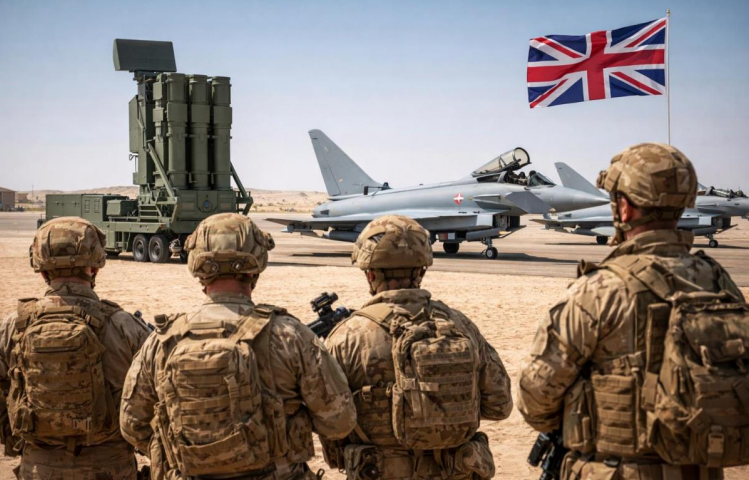
The United Kingdom has significantly increased its military presence in the Gulf, deploying up to 1,000 troops alongside advanced air defence systems in response to escalating regional threats. The move comes amid intensifying attacks attributed to Iran and growing concerns over the safety of critical infrastructure and energy routes across the Middle East.
Announced by UK Defence Secretary John Healey during his visit to Gulf nations, the deployment includes the expansion of Royal Air Force Typhoon fighter jet operations in Qatar and the installation of the Sky Sabre missile defence system across Saudi Arabia, Bahrain, and Kuwait.
This development reflects a broader strategic shift, as global powers increasingly move to secure the Gulf region—not only for geopolitical stability but also to protect global energy flows. The UK Gulf Deployment has emphasized that its actions are defensive in nature, aimed at reinforcing allied security rather than escalating the conflict.
Scale and Scope of the UK Military Deployment
The UK Gulf Deployment marks one of its most substantial military commitments to the Gulf in recent years. Officials confirmed that nearly 1,000 British personnel are now positioned across the Middle East, tasked with strengthening defence infrastructure and supporting regional allies.
These troops are not only responsible for operational duties but also for installing, training, and maintaining advanced defence systems. Their role includes integrating British systems with existing Gulf defence networks, ensuring a coordinated and rapid response to aerial threats such as drones and missiles.
In addition to ground deployments, the UK is reinforcing its air capabilities by extending the presence of Typhoon fighter jets in Qatar, where it operates a joint squadron. This move ensures continuous aerial surveillance and rapid interception capability across key areas of the Gulf.
Advanced Defence Systems and Strategic Capabilities
At the center of the deployment is the Sky Sabre air defence system, one of the UK’s most advanced ground-based missile platforms. Designed to counter drones, aircraft, and missile threats, the system significantly enhances the defensive capabilities of Gulf allies.
Sky Sabre operates with a sophisticated radar and control network, capable of detecting and intercepting multiple threats simultaneously. Its deployment across Saudi Arabia, Bahrain, and Kuwait reflects the increasing need for multi-layered air defence systems in the region.
Complementing this system are additional British defence assets, including counter-drone technologies and missile launch platforms. These systems are being integrated into regional defence frameworks, creating a more resilient and coordinated security architecture across the Gulf.
Geopolitical Context and Rising Regional Tensions
The UK Gulf Deployment decision comes against the backdrop of escalating tensions between Iran and Western-aligned forces. Recent attacks targeting infrastructure and shipping routes have heightened concerns about regional stability and global economic security.
Defence Secretary John Healey stated that Iran’s actions are “expanding” and continue to threaten allied nations, underscoring the urgency of the deployment. The UK has condemned these attacks and reaffirmed its commitment to protecting both its interests and those of its partners.
At the same time, the UK is navigating a delicate diplomatic balance. While reinforcing its military presence, it has avoided direct participation in offensive operations, signaling a preference for defensive engagement and strategic restraint.
Implications for Regional Security and Global Energy Stability
The Gulf region remains a critical hub for global energy supply, with key shipping routes such as the Strait of Hormuz playing a central role in oil transportation. Any disruption in this region has immediate implications for global markets and economic stability.
By deploying troops and advanced defence systems, the UK aims to safeguard these vital routes and ensure the uninterrupted flow of energy resources. This is particularly important as recent attacks have highlighted vulnerabilities in both infrastructure and maritime operations.
The move also signals a broader international effort to stabilize the region. By working closely with Gulf allies and integrating defence systems, the UK is contributing to a collective security framework designed to deter further escalation and protect global economic interests.
Outlook
The UK’s expanded military deployment to the Gulf represents a significant escalation in defensive measures amid rising regional threats. With nearly 1,000 troops, advanced missile systems, and extended air operations, Britain is positioning itself as a key security partner in the region.
In the short term, the focus will remain on strengthening defence capabilities and ensuring coordination with allied nations. The effectiveness of these measures will depend on their ability to deter attacks and maintain stability without triggering further escalation.
Looking ahead, the situation underscores the growing intersection of geopolitics, energy security, and military strategy. As tensions persist, the Gulf is likely to remain a focal point of global attention, with the UK Gulf Deployment and other powers playing a critical role in shaping its future trajectory.