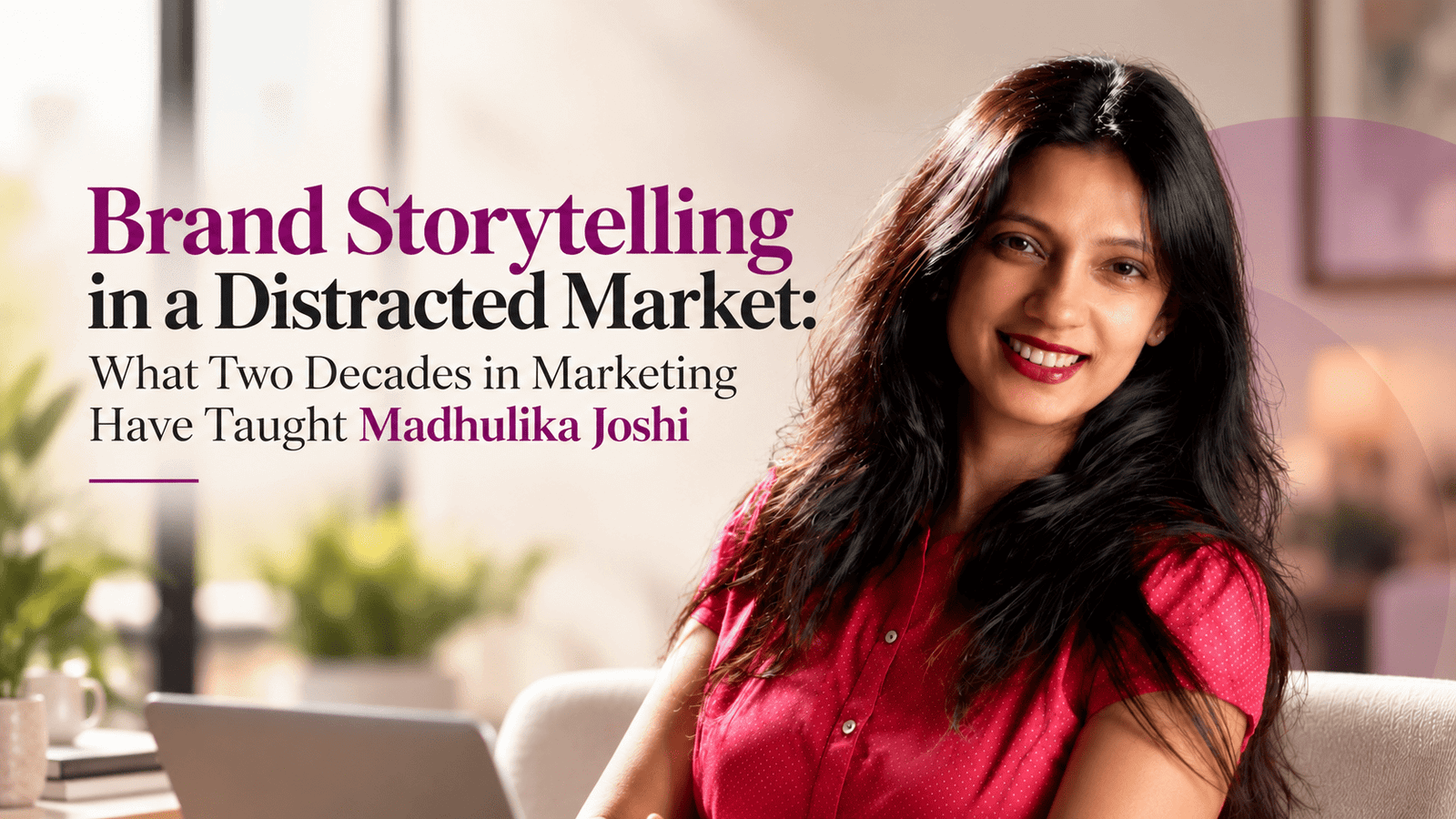
From Amul-era one-liners to endless Instagram scrolling, the founder of Martist Services on what makes brand content last, and why simpler, more human messaging is likely to win.
A hotel group that greets guests the same way every season. A chocolate maker whose festive advertising still makes people smile. A cartoon girl who has commented on the news for decades. The brands that last tend to say something simple, say it well, and keep saying it.
Madhulika Joshi has spent more than twenty years watching which messages last. She began in 1999 in the brand communication team of Leela Ventures, part of the Leela Group of Hotels, and moved through senior marketing roles across hospitality, lifestyle, retail and wellness before founding Martist Services Pvt. Ltd., an integrated marketing agency. Her view of content comes from both sides of the client relationship, and it is more practical than fashionable.
From Copywriter Ambition to Brand Builder
Joshi’s route into marketing was not the one she planned. After an MBA in advertising and PR, she wanted to write copy at a creative agency in Mumbai, and she had been crafting quirky lines since college. Her first job, at Leela Ventures, put her inside a brand instead. Roles were less defined than they are now, and she worked across PR, media relations and the agencies that made the advertising. She liked the breadth, and she stayed with brand marketing, including work on Hobby Ideas, an arts and crafts initiative launched under Pidilite Industries and Fevicol.
From Slogans to a Stream of Formats
When Joshi started out, a brand’s voice often lived in a slogan, a punchline or a tagline. Amul’s witty advertisements are her example of how well that worked. Content was limited in format and reach, and a clever one-liner was enough.
Today content has split into formats and channels that each need their own approach. Digital platforms, traditional media and everything between them call for different treatment, and she says one-size-fits-all strategies no longer work. Video has taken centre stage, and visual content now ranks above written content in popularity.
Under all of it sits a quality she keeps returning to, which is relatability. Content that connects with its audience is more likely to succeed, whatever the format.
What Good Content Looks Like
Asked what makes content good, Joshi gives a plain answer: simplicity and effectiveness. She believes marketers often overcomplicate things in the effort to stand out, piling on flashy elements when a clear message would carry further. Adding an emotional dimension, she says, makes content easier to relate to and more memorable.
Her examples are familiar ones. Cadbury’s festive content is simple, emotionally resonant and well matched to Indian consumers. The Amul Girl campaign has endured for years on simplicity and wit. Neither depends on production scale or novelty. Both depend on knowing the audience well.
In-Moment Marketing and Its Limits
Joshi acknowledges the pull of in-moment marketing, where brands tie their content to trending topics and current events to catch fleeting attention. It can work when the connection is relevant. But not every brand can use it, and agility counts for more than imitation. A brand has to know what resonates with its own audience.
She illustrates the challenge with a conversation she had with someone who had watched people scroll through Instagram. They moved at lightning speed and barely stopped to read. Content now has about a moment to land. It has to grab attention instantly and sit naturally in the environment where it appears.
Digital Fatigue and What Comes Next
Looking three to five years ahead, Joshi expects artificial intelligence to become more integral to how companies, creative agencies and content creators operate. It will make marketing more personalised and more efficient, she says, as brands respond to the individual preferences and behaviour of consumers.
She also sees a counter-trend building. There is a growing sense of saturation and digital fatigue. Many people, herself included, feel overwhelmed by the constant flow of content and advertising. Some will look for more privacy and a break from the relentless digital environment, and marketers may need to find ways of reaching them that are less intrusive and more meaningful. Nostalgia marketing, as seen in the return of 1990s-era content, could become a trend as people look for simpler times.
For sectors built on experience and trust, such as hospitality, retail and wellness, the fatigue argument carries particular weight. People choose hotels, shops and wellness providers partly on feeling. A brand that talks at its audience without pause risks losing the warmth that attracted them in the first place. Joshi puts the future of marketing down to one question, which is how well brands can balance advanced technology with what consumers actually want.
Why Consistency Beats Cleverness
Joshi’s emphasis on telling a story consistently across platforms reflects a problem many brands share. A campaign may be strong in one place and forgotten in the next. A brand’s social media voice may differ from its advertising, and its PR may say something else again. An audience moving quickly through a feed only has to meet that inconsistency once to lose the thread.
Her answer is to settle the story first and then spread it. Work out what the brand is really about, shape that into something specific, and let every channel carry the same idea in its own way. It is less glamorous than chasing a trend, but it gives content a better chance of lasting.
Staying Informed Without Chasing Every Trend
For anyone starting a marketing career, Joshi’s first piece of advice is to stay relentlessly informed. The field changes quickly, with new technologies, trends and platforms arriving all the time. She recommends keeping up even with developments that look irrelevant to your current role, because you never know when they will matter.
Her second piece of advice balances the first. The fundamentals of marketing are lasting, and they give a marketer a framework for understanding consumer behaviour whatever tools are fashionable. Her third is about nerve. Marketers should resist pressure from brands or clients to adopt every new trend without understanding whether it is relevant and effective.
That, she says, comes with a responsibility to educate. Clients and organisations need to understand the nuances of marketing, especially in the digital space. One point she stresses is that return on investment is not only about immediate monetary gains. Reach and engagement matter too. Setting those expectations early makes for better working relationships.
What Hospitality, Retail and Wellness Brands Can Take From This
Joshi’s career and Martist’s work sit in hospitality, retail, wellness, lifestyle and travel, sectors where people buy on feeling as much as on features. Her ideas translate into a few plain habits. Keep the message simple enough for the audience to repeat. Add an emotional layer, whether through a festive moment, a sense of welcome or a sense of care. Treat trends as optional and use them only when they genuinely fit the brand.
None of this needs a large budget. It needs a clear view of who the brand is speaking to and the discipline to stay on message.
How Martist Puts This Into Practice
Martist is an integrated marketing agency built around storytelling. “We believe every brand has a story, but the real value lies in identifying the right story, shaping it meaningfully, and telling it consistently across platforms and touchpoints,” Joshi says.
Its services include brand strategy, creative communication, social media, digital and performance marketing, content, campaigns, influencer engagement, PR support, design and visual storytelling. The agency starts with the business objective and builds the communication around the audience and the brand context. Experience in hospitality, retail, wellness, lifestyle and travel lets the team carry what works in one sector into another.
The company’s own stated purpose is to creatively inspire those with big ideas and keep igniting their dreams. It is built on the belief that every marketer is an artist.
Looking Ahead
Over the next five years, Joshi wants Martist to be known as an integrated, strategy-led partner with strong storytelling and sharper thinking. She plans a more selective portfolio of high-value clients and more proprietary thinking, and she wants the company to mentor young professionals entering the industry.
Her advice to aspiring entrepreneurs fits the same temperament. “Do not wait for everything to be perfect before starting, but also do not confuse speed with progress,” she says. “Start with clarity on why you want to build the business, not just what you want to sell.”
Frequently Asked Questions
What makes brand content last?
According to Joshi, simplicity and emotional connection. Content that conveys its message clearly and feels relatable tends to outlast content that relies on complexity or flashy elements.
What is in-moment marketing?
In-moment marketing ties brand content to trending topics and current events to capture attention while it is available. It works best when the connection is relevant, and not every brand can use it.
How will marketing change in the next few years?
Joshi expects artificial intelligence to enable more personalised marketing, alongside growing digital fatigue that may push consumers toward privacy, simplicity and nostalgia.
About Madhulika Joshi
Founder, CEO & Chief Creative Officer, Martist Services Pvt. Ltd. Website | LinkedIn | Instagram: madhulika.inspire ( https://www.instagram.com/madhulika.inspire/ )
Published by The Gulf Times.