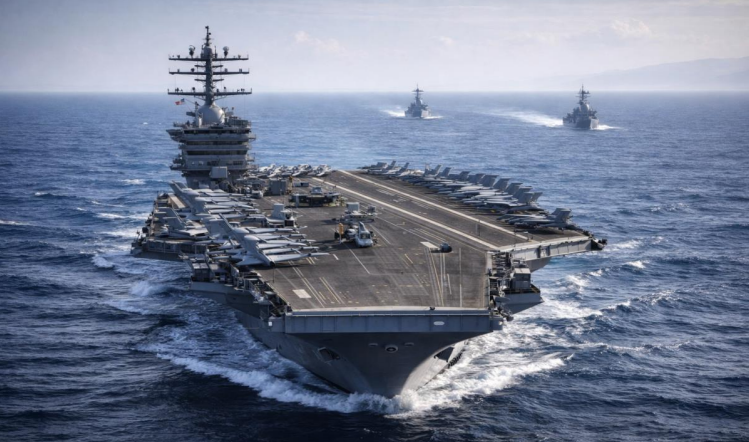
A Navy US Aircraft Carrier strike group has arrived in the Middle East amid sharply escalating tensions with Iran, marking one of Washington’s most significant military deployments to the region in recent years. The arrival of the carrier equipped with advanced fighter jets, surveillance assets, and missile-defence systems comes at a time of heightened security concerns in the Gulf, renewed proxy activity, and increasing confrontations involving Iranian forces and regional partners of the United States.
Senior US Aircraft Carrier defence officials confirmed that the carrier had entered operational waters in the US Central Command (CENTCOM) area on January 26, 2026, following weeks of strategic repositioning. The deployment is aimed at enhancing maritime security, protecting commercial shipping routes, and deterring hostile actions that could destabilise the region’s geopolitical landscape.
Pentagon spokespersons stated that the move is “a preventive security measure designed to protect US Aircraft Carrier personnel, regional allies and international commercial interests,” emphasising that the United States “does not seek conflict but will act decisively to defend freedom of navigation and regional stability.”
Strategic Deployment
The arrival of the carrier marks a deliberate strengthening of US Aircraft Carrier presence across vital waterways, including the Strait of Hormuz, the Gulf of Oman, and the Red Sea. These routes collectively carry approximately one-fifth of the world’s oil shipments, making them among the most strategically sensitive maritime corridors globally.
The deployed strike group includes:
- A full-deck nuclear-powered aircraft carrier
- An accompanying cruiser equipped with Aegis missile-defence systems
- Two guided-missile destroyers capable of long-range interception
- A logistics support vessel
- Air Wing assets comprising F/A-18 Super Hornets, EA-18G Growler electronic warfare jets, E-2D Advanced Hawkeye surveillance aircraft, and ASW helicopters
This composition gives the United States substantial air, sea and electronic warfare capability, enabling real-time surveillance of regional hotspots and offering rapid-response options should tensions escalate further.
Defence analysts note that the strike group’s movement through the Suez Canal earlier in the week signaled Washington’s intentions to reinforce the region, following multiple intelligence assessments warning of increased Iranian military activity.
Rising Iran Tensions: Drone Attacks, Naval Confrontations and Diplomatic Strain
The deployment follows a series of developments over the past 30 days that significantly escalated tensions between Washington and Tehran. According to defence briefings, Iranian-backed militias increased drone and missile activity targeting US-aligned locations across parts of the Middle East.
Although most attacks were intercepted, several episodes prompted concerns within CENTCOM about Iran’s growing readiness to project power through its network of regional proxies.
Naval confrontations also intensified in the Gulf of Oman, where US Aircraft Carrier destroyers reportedly monitored attempts by Iranian patrol craft to shadow commercial tankers. In early January, an incident involving harassment of an international cargo vessel raised alarms within global shipping networks and prompted demands for increased multinational maritime security cooperation.
Diplomatic channels between the United States and Iran have remained largely dormant, with indirect communication via European intermediaries failing to de-escalate tensions. Iran’s foreign ministry accused the US Aircraft Carrier of “provocative military posturing,” while Washington maintained that the deployment was a direct response to actions threatening regional security and freedom of navigation.
Gulf States Heighten Security Coordination
Gulf nations, including the United Arab Emirates, Bahrain, Qatar, Oman and Saudi Arabia, have intensified coordination with the United States in light of the escalating tensions. Several states issued updated maritime advisories urging cargo operators to follow secure transit routes and to maintain direct communication with naval authorities when traversing high-risk zones.
Bahrain, home to the US Aircraft Carrier Fifth Fleet headquarters, confirmed increased operational engagement and readiness support for patrol missions. Officials in Abu Dhabi and Riyadh also held high-level consultations to assess regional contingency planning, particularly in relation to energy infrastructure and offshore oil platforms.
As global oil markets remain sensitive to instability in the Gulf, analysts noted a temporary rise in crude futures linked to concerns over potential disruptions. Traders emphasized that long-term volatility will depend heavily on whether the situation de-escalates or if fresh confrontations emerge.
US Aircraft Carrier Domestic Context
Within the United States, the deployment underscores Washington’s broader strategic recalibration in the Middle East. While recent years saw a reduction in large-scale military presence, renewed threats from Iran and its regional networks have prompted a shift toward forward-deployed deterrence.
Military experts highlighted that the deployment coincides with several geopolitical deadlines, including upcoming meetings of the International Atomic Energy Agency (IAEA) to assess Iran’s nuclear compliance and renewed discussions among European and Gulf nations regarding sanctions enforcement.
Congressional leaders from both major political parties issued statements supporting the deployment, citing the need to counter increasing Iranian aggression. The Pentagon reiterated, however, that the United States “remains open to diplomatic solutions” while reserving the right to act in collective defence.
Conclusion
The US Aircraft Carrier aircraft carrier’s arrival in the Middle East at a time of heightened friction with Iran marks a significant geopolitical moment, reinforcing Washington’s commitment to regional stability and secure maritime commerce. With global trade routes, energy supplies, and diplomatic relations at stake, the deployment signals a mix of deterrence and strategic preparedness aimed at preventing further escalation.
As intelligence assessments continue to warn of evolving security threats, the focus now shifts to how Iran responds to the strengthened US Aircraft Carrier military presence and whether regional diplomacy can offset rising tensions. Analysts caution that while the carrier’s arrival may temporarily stabilize the situation, sustained peace will depend on broader diplomatic engagement, restraint from regional actors, and coordinated international efforts to safeguard vital shipping lanes and prevent conflict escalation.