
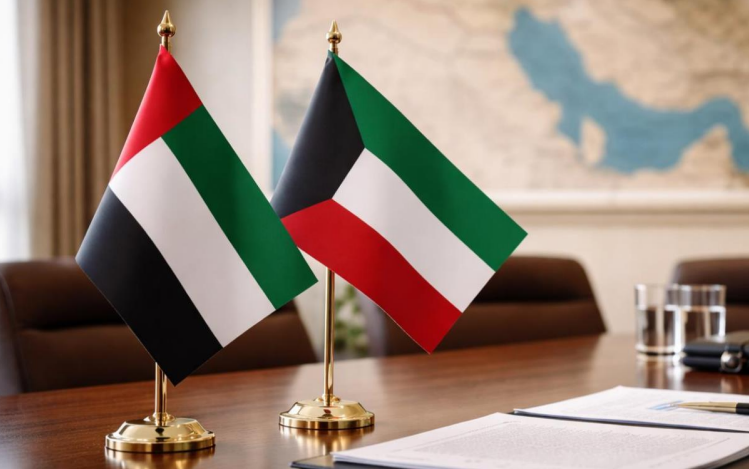
The United Arab Emirates has formally reiterated its full support for UAE Kuwait Maritime sovereignty and expressed concern over Iraq’s recent submission of new maritime coordinates to the United Nations, a move that Kuwait considers inconsistent with previously agreed boundaries.
The UAE Ministry of Foreign Affairs issued a firm statement underscoring unwavering solidarity with Kuwait’s right to safeguard its territorial integrity, UAE Kuwait Maritime rights, and regional security interests. Senior Emirati and Kuwaiti diplomats have confirmed that the issue connected to navigation routes, oil terminal access and control over critical maritime zones in the northern Gulf has now become a central subject of Gulf regional diplomacy.
The diplomatic exchange has emerged as Iraq submitted maritime coordinate updates to the UN Division for Ocean Affairs and the Law of the Sea. Kuwait maintains that the submission violates binding agreements including Security Council Resolution 833, which demarcated the land and maritime boundary between Kuwait and Iraq following the 1991 Gulf War. Today’s statement from the UAE marks one of the strongest regional expressions of support for Kuwait since the new Iraqi documentation became public.
UAE’s Official Position and Strong Diplomatic Message
The UAE Ministry of Foreign Affairs, through an official spokesperson, emphasised that the country “stands firmly and without hesitation beside the State of Kuwait in every measure it takes to protect its legitimate rights.” The ministry’s statement further stressed that Kuwait’s sovereignty, particularly over its maritime zones, is “a stabilising pillar of Gulf regional security, international navigation, and economic continuity.”
The UAE also voiced “deep concern” over what it described as Iraq’s unilateral action to alter or reinterpret maritime boundaries that were internationally recognised and endorsed by the United Nations over three decades ago. Diplomatic sources in Abu Dhabi confirmed that Emirati officials have been coordinating with Kuwaiti counterparts over the past week, reviewing technical maps and the implications for shared Gulf maritime routes. The UAE Kuwait Maritime message is seen as reinforcing Gulf unity and deterring any attempts that threaten regional territorial frameworks.
Background: The Kuwait–Iraq Maritime Boundary Issue
At the centre of the dispute lies the handling of UAE Kuwait Maritime boundaries near the northern tip of the Arabian Gulf, specifically around Khor Abdullah, where the two states share navigation channels with critical access to ports and offshore terminals. This area hosts key facilities including Kuwait’s Mubarak Al-Kabir Port and Iraq’s Umm Qasr Port, both vital to regional commercial shipping.
The roots of the boundary framework trace back to UN Security Council Resolution 833 (1993), which mandated international demarcation following the liberation of Kuwait. Kuwait argues that Iraq’s new submission deviates from these lines and undermines a binding international decision.
Over the past year, several technical committees between Kuwait and Iraq have attempted to re-establish a consensus on navigation protocols but have failed to reach final agreement. This latest submission to the UN has reignited tensions, prompting robust responses from the Gulf Cooperation Council member states.
Regional Reactions and GCC Alignment
Beyond the UAE, other Gulf countries are reportedly preparing to issue supportive statements for Kuwait, as the matter is now viewed as a test of Gulf collective security. Analysts in regional think tanks say that the timing—coming amid wider geopolitical shifts in the region—has increased the urgency for unified Gulf messaging.
Initial indications suggest that Saudi Arabia, Bahrain, and Qatar may echo similar positions to underline the principle of non-interference in sovereign maritime affairs.
The GCC Secretary-General, Jasem Al-Budaiwi, recently stated in a closed ministerial meeting that “GCC unity is paramount, and maritime sovereignty is a red line that the Council will not allow to be crossed.” Although the statement was not officially published, senior diplomats later confirmed its sentiment. The UAE’s latest declaration has further bolstered Kuwait’s diplomatic leverage as it prepares its own formal communication to the UN contesting Iraq’s coordinate submission.
Kuwait’s Legal and Diplomatic Position at the UN
Kuwait is expected to respond through its permanent mission in New York, presenting a detailed legal and cartographic rebuttal. Officials privy to the preparations say the response will reaffirm the inviolability of Resolution 833 and argue that Iraq’s alternative maritime coordinate proposals lack legal standing under the UN Convention on the Law of the Sea.
Kuwait will also highlight previous bilateral agreements, including the 2012 navigation arrangement between the two countries, which established joint control mechanisms in the Khor Abdullah channel. Kuwaiti diplomats have reiterated that Iraq’s recent actions “risk undermining decades of painstaking UAE Kuwait Maritime negotiations and reconciliation efforts.”
According to external UAE Kuwait Maritime law experts, Kuwait is likely to receive broad international support, as its claim is grounded in a UN-led demarcation rather than bilateral arrangements alone.
Implications for Gulf Security, Energy Shipping, and International Waters
The disputed waters hold strategic importance for oil exports, supply chains, and military coordination in the northern Gulf. Kuwait currently manages extensive shipping routes linked to its refining sector and LNG import terminals, while Iraq relies heavily on its access to Umm Qasr and Al-Faw.
Any ambiguity in maritime boundaries could generate risks for shipping insurance, port logistics, and offshore energy infrastructure planning.
The UAE’s strong endorsement of Kuwait carries broader implications for regional security frameworks. Maritime boundaries in the Gulf are tightly interlinked with defence cooperation and critical infrastructure protection. Experts suggest that the synchronized reaction from Gulf states acts as a deterrent against unilateral attempts to alter long-recognised borders.
The UAE stressed that maintaining stable maritime routes is essential not only for Kuwait’s economic security but for Gulf-wide prosperity.
Conclusion
The UAE’s declaration of solidarity underscores rising concerns over unilateral geopolitical manoeuvres in the region. As Kuwait prepares its detailed legal response to the UN, the dispute may evolve into a broader test of Gulf unity, rule-based boundary governance, and collective security principles.
With diplomatic consultations ongoing and GCC members signalling increasing alignment, regional observers expect sustained attention on the developments at the United Nations in the coming weeks.