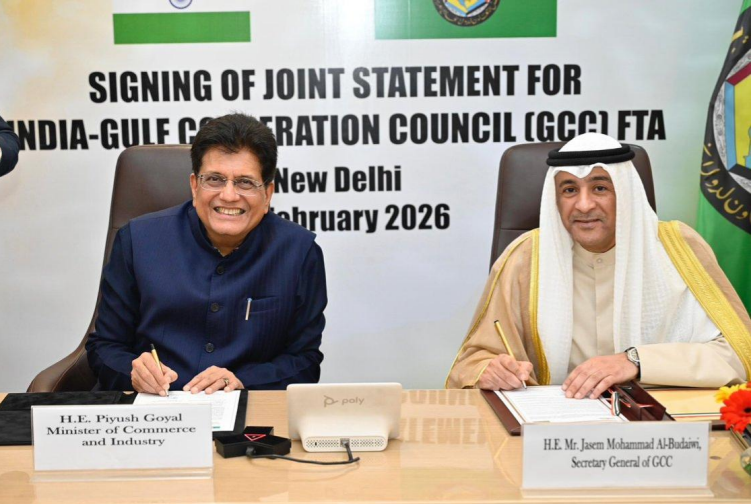
The Gulf Cooperation Council (GCC) has formally commenced negotiations with India toward establishing a comprehensive Free Trade Agreement (FTA), following the signing of a Joint Statement in New Delhi by GCC India FTA Secretary-General Jasem Mohammad Al Budaiwi and India’s Commerce Minister Piyush Goyal. The decision marks a significant strategic step for the Council as it accelerates efforts to diversify regional economies and expand global economic partnerships.
For the GCC India FTA, the launch of negotiations reflects its growing ambition to shape major trade frameworks beyond the Middle East, strengthen non-oil sectors and secure long-term commercial linkages with one of the world’s fastest-growing economies. Officials noted that India, now among the GCC’s top global trading partners, offers a deep consumer market, advanced digital infrastructure and large-scale manufacturing capacity aligned with the Council’s economic transformation goals.
GCC’s Strategic Push for Global Economic Diversification
The FTA initiative aligns with GCC member states’ long-term economic visions, including Saudi Vision 2030, UAE Centennial 2071, Qatar National Vision 2030, Oman Vision 2040, and ongoing diversification agendas in Kuwait and Bahrain. Secretary-General Al Budaiwi emphasized that the GCC India FTA is prioritizing the establishment of high-value partnerships with rapidly expanding economies such as India to secure future growth avenues.
The GCC’s renewed engagement with India also reflects its goal of enhancing supply-chain resilience and broadening export markets beyond hydrocarbons. Officials highlighted that the Council’s combined non-oil GDP has grown significantly, supported by logistics, manufacturing, digital services and financial technology, all of which are expected to benefit from improved trade access under the FTA. Regional policymakers view India as a key demand hub capable of absorbing GCC India FTA investments and supporting deeper economic integration across sectors.
Expanding Trade Channels and Investment Corridors
India is already one of the GCC’s largest trading partners, with bilateral trade surpassing USD 155 billion in the most recent financial year. For the Council, formalizing an FTA is expected to expand export routes, reduce tariff barriers and strengthen logistics connectivity across ports and trans-shipment hubs in the Gulf. GCC India FTA officials believe the agreement will help consolidate the region’s position as a central gateway between Asia, Africa and Europe.
Investment flows from the GCC to India have accelerated in recent years, led by sovereign wealth funds such as PIF, ADIA, QIA, Kuwait Investment Authority (KIA) and Bahrain Mumtalakat. The FTA is expected to provide a more structured environment for these capital movements, ensuring clearer regulatory frameworks, investor protections and opportunities for long-term joint ventures in renewable energy, data infrastructure, real estate and advanced manufacturing.
Trade analysts in the Gulf predict that the FTA could push India–GCC commerce to nearly USD 250–280 billion in the medium term, with strong contributions from petrochemicals, metals, logistics, food security partnerships and technology-driven sectors.
Technology Cooperation and Digital Economy Integration
Technology is expected to emerge as one of the defining elements of the GCC India FTA. Gulf nations — particularly the UAE, Saudi Arabia and Qatar — have invested heavily in artificial intelligence, smart-city platforms, cloud infrastructure and digital governance systems. India’s established digital public infrastructure and talent base provide complementary strengths that can support GCC projects aimed at modernising essential services and expanding digital enterprises.
GCC India FTA officials have confirmed interest in frameworks enabling seamless cooperation in areas such as cybersecurity, fintech interoperability, AI development and data-governance standards. The agreement could also promote talent mobility through streamlined visa norms for skilled professionals, reflecting the GCC’s push to attract global human capital to power its emerging innovation economies.
Several Gulf governments already collaborate with Indian technology firms on cloud distribution networks, municipal services, mobility solutions and public-sector digital transformation. The FTA is expected to institutionalize these efforts and create long-term technology partnerships.
Energy Transition and Next-Generation Resource Alliances
While hydrocarbons remain foundational to GCC economies, the region is rapidly investing in renewable solutions, clean-energy storage and hydrogen production. GCC negotiators emphasized that the FTA provides a platform to expand cooperation with India in green hydrogen, solar manufacturing, grid modernization and low-carbon industrial systems.
Saudi Arabia, UAE and Oman are among the global frontrunners in developing large-scale hydrogen hubs and renewable megaprojects. India’s growing demand for clean energy and its emerging hydrogen economy provide significant opportunities for structured long-term agreements. GCC energy strategists noted that the partnership will help build new energy corridors and accelerate investment in future-ready technologies.
In addition, the FTA could create frameworks for joint research between GCC India FTA energy transition agencies and Indian institutes, supporting development of advanced electrolyser technologies, desalination efficiency tools and carbon-capture solutions.
Mobility, Workforce Integration and Policy Harmonisation
With more than nine million Indian nationals living and working in the Gulf, workforce integration remains central to GCC economies. Officials indicated that the FTA will explore new provisions for skill recognition, labour mobility and efficient recruitment processes. GCC governments are seeking a more predictable system that supports local development goals while ensuring safe and transparent conditions for foreign workers.
The agreement is also expected to cover policy harmonisation in areas such as customs procedures, product certification, dispute-resolution mechanisms and intellectual-property protection. These measures aim to reduce administrative inconsistencies across GCC member states and facilitate smoother trade operations with Indian partners.
Economists within the region view the potential FTA as a strategic tool to reinforce the GCC’s position as one of the world’s most integrated economic blocs. By securing a structured framework with India, the Council strengthens its global trade network and enhances its role as a connector between fast-growing markets.