Dubai has once again positioned itself ahead of the global curve with its latest announcement on future mobility. Speaking at the World Governments Summit, Mattar Al Tayer, Director General and Chairman of the Roads and Transport Authority (RTA), confirmed that the emirate will launch commercial air taxi services by the end of this year, with self-driving taxis set to roll out in early 2026. The declaration reflects more than an operational update; it signals the city’s readiness to transform its transport network through innovations that until recently belonged to the realm of futuristic possibility.
Al Tayer presented the timeline with a sense of conviction that has come to define Dubai self-driving taxis governance model. When he spoke of the city’s approach to future projects, “We do what we say, and we say what we do”, it carried both confidence and accountability. Dubai’s promise to deliver these projects within the announced timeframe is supported by years of groundwork, a mature regulatory environment, and robust public-private partnerships that are now converging to reshape the city’s mobility architecture.
Air Taxis: Bringing Vertical Mobility Into Daily Life
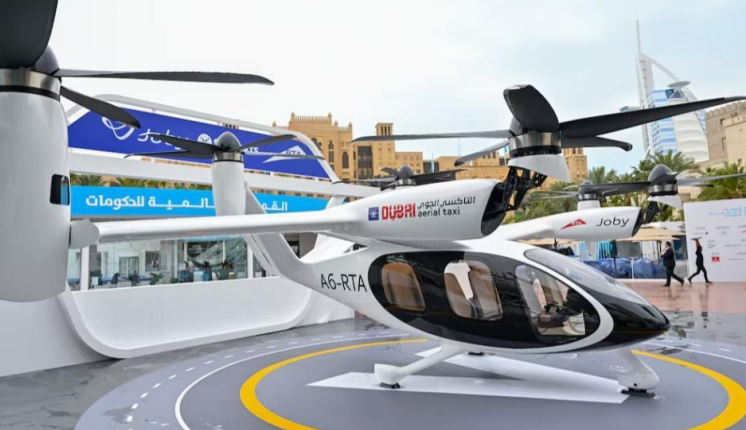
The arrival of commercial air taxis marks a historic chapter in Dubai’s transport evolution. For years, the concept of aerial mobility has been a global aspiration, but Dubai self-driving taxis is moving it from ambition to operation. By the end of this year, commuters will be able to book electrically powered vertical take-off and landing aircraft that bypass ground traffic and connect key nodes across the city within minutes.
This is not merely a technological demonstration, but a structured mobility service designed to integrate with Dubai self-driving taxis existing urban fabric. The city has been preparing dedicated air corridors, advanced vertiport locations and early operational frameworks to ensure that air taxis become a functional component of everyday travel rather than a novelty reserved for special occasions.
Each corridor is being developed to serve areas of high economic density, business districts, airports, tourist hubs and waterfront destinations, ensuring that the service offers both practical utility and a distinctive mobility experience.
Dubai’s decision to commercialise air taxis ahead of global competitors reflects its determination to remain a first-mover in future transport technologies. At a time when many major cities are still at the conceptual or pilot-testing stage, Dubai self-driving taxis is preparing to introduce a service that is embedded within its broader smart-city vision and aligned with its long-term sustainability goals.
Self-Driving Taxis: A Ground-Level Transformation in 2026
Parallel to its aerial ambitions, Dubai self-driving taxis is preparing the ground for another major transition: the launch of driverless taxis in early 2026. These autonomous vehicles represent a significant step toward a mobility environment that is defined by precision, predictability and safety.
They will operate under a dedicated monitoring system and will communicate continuously with the city’s intelligent transport infrastructure, creating a highly controlled, highly supervised network for automated travel.
Dubai has laid the regulatory and technological foundation for this shift over the past several years, enabling the integration of autonomous systems with real-world road conditions. The upcoming rollout is expected to provide a seamless, round-the-clock mobility option that reduces human error, enhances road safety and offers consistent service reliability.
For a city that attracts millions of residents and visitors each year, the introduction of autonomous taxis is not only a technological milestone but also a major step toward improving the efficiency and accessibility of everyday transportation.
The RTA’s timeline underscores Dubai’s confidence in the maturity of the technology and its readiness to transition from testing phases to a structured commercial ecosystem. The launch will also support Dubai’s long-term vision of converting a significant share of its mobility to autonomous systems by the end of the decade.
Building the Ecosystem Behind the Vision
What distinguishes Dubai’s mobility programme is its emphasis on ecosystem building. Air taxis and autonomous taxis are not isolated projects; they are part of an interconnected transport framework designed to accommodate both vertical and ground-level movement with equal fluidity.
Over the years, Dubai has invested heavily in digital road infrastructure, real-time monitoring hubs, advanced mapping environments, and sustainable transport corridors, all of which create the foundation required for next-generation mobility to succeed on a citywide scale.
The emirate’s approach reflects a philosophy that innovation is only meaningful if it is supported by a durable operational environment. By aligning policy, infrastructure and technology years in advance, Dubai has positioned itself to adopt disruptive mobility solutions faster than any other region in the world.
This long-view strategy is now allowing the city to move confidently toward commercial deployment while maintaining its strong emphasis on safety, regulatory clarity and long-term sustainability.
Dubai’s Future Ambition
Dubai’s decision to introduce air taxis within months and self-driving taxis shortly thereafter sends a strong message to the global community. While many cities debate the viability of such technologies or experiment with controlled test zones, Dubai is preparing to integrate them into its daily life and economic rhythm.
This reflects a broader national ambition to remain at the forefront of global innovation, to attract forward-looking investments and to shape future-ready infrastructure that responds to the expectations of a rapidly changing world.
By advancing these mobility solutions simultaneously, Dubai is redefining what urban transportation can look like in the next decade. It demonstrates that the future of mobility is not confined to research labs or pilot programmes—it can be lived, experienced and refined in real time.
The city’s model offers a roadmap for other global hubs seeking to embrace technology-driven transport systems while maintaining operational stability and public trust.