
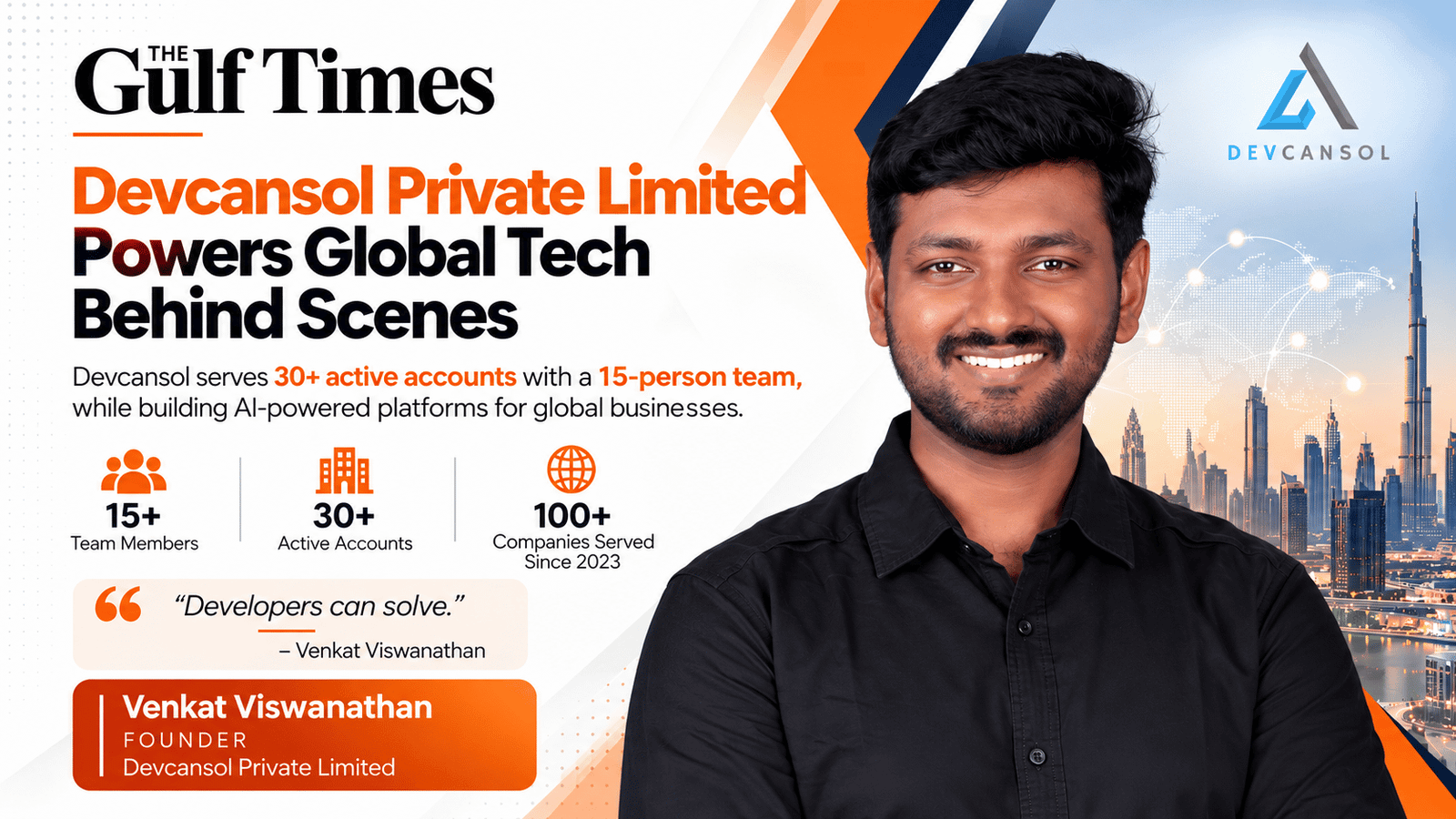
Venkat Viswanathan’s Devcansol Private Limited works as the offshore engineering arm for software firms abroad — and is now building AI-driven platforms of its own.
For Gulf businesses evaluating offshore technology talent and AI-enabled services, the story of Devcansol Private Limited and its founder, Venkat Viswanathan, offers a look at how the partnership model works in practice — and what happens when it is put under stress.
Venkat Viswanathan: A Career Built on Understanding Both Sides of a Deal
Venkat’s background is unusual for a tech founder: he started in finance, producing valuation reports and amortization schedules for the American commercial real estate sector while based in Chennai, before completing his articleship in Coimbatore. In March 2020 he joined a risk analysis team, and at his next role, with Verumex, worked as an analyst translating financial and business requirements into technical specifications for engineering teams — sitting exactly at the seam between what a business needs and what a system can deliver.
Noticing him teaching himself Python and SQL, his mentor Brittian Warner moved him onto the technical track, where he went on to build data pipelines standardizing feeds from over 120 data providers across more than 30 countries.
In 2023, Venkat founded Devcansol on a single idea: businesses should not need to write code to get answers from their own data — AI could handle that translation instead.
Devcansol’s Offshore Engineering Model: Representation and Delivery
Devcansol’s core services business works as an extended technical team for software companies, largely based in the United States, functioning as their offshore engineering capability. In many cases, it represents those companies directly to their own end clients. Alongside this, Devcansol serves as a technical partner for non-technical business owners internationally who have a product vision but no in-house engineering team.
The company also builds and operates its own platform, Ripple, which layers an enterprise-grade system behind a client’s website: a built-in CRM, a referral management tool, a productivity suite for task and attendance tracking, a CMS, and a role-based AI assistant serving both public users and internal teams.
For US real estate clients specifically, Ripple provides automated rent and home-value estimation tools with comparable-property benchmarking — the kind of vertical-specific AI tooling that international service buyers are increasingly demanding from their outsourcing partners.
Weathering Client Concentration in a Cross-Border Services Business
Any company that depends heavily on a small number of overseas clients carries a structural risk, and Devcansol confronted it directly in 2025 when it lost its two largest engagements within a short window. One project concluded naturally; the other ended when the client’s own founders wound their business down amid internal disagreement.
Rather than letting years of client relationships lapse, Venkat proposed a continuity arrangement: Devcansol would take over service delivery for the affected clients, with the departing founders receiving a commission. It kept the end clients served without disruption, compensated the exiting founders, and gave Devcansol the cash flow to hold its team together through several difficult months.
That inherited client base became the seed of the Ripple platform brand. The crisis also pushed Devcansol to restructure how it scales — converting repeatable service work into reusable, white-labelled platform components that can serve new clients without proportional headcount growth.
According to Venkat, the company now operates with a team of fifteen supporting around thirty active accounts, having worked with more than a hundred companies globally since 2023.
AI Platforms and the Future of Cross-Border Tech Services
Venkat sees the broader outsourcing and AI-services market moving toward what he calls “services delivered as software” — the inverse of the infrastructure-, platform-, and software-as-a-service waves that came before.
Configuration and integration work that consultants once billed by the hour is increasingly something the system can do on its own. International clients can get solutions that adapt with their business rather than needing a fresh engagement every time something changes.
Ripple, he says, is Devcansol’s first real proof point of that shift. The goal over the next five years is for product revenue to carry the majority of the company’s growth alongside its services depth.
His advice for founders building cross-border businesses: keep a financial reserve independent of growth optimism, since even solid plans rarely land exactly as expected — and judge international partners by what they deliver, not only by what they promise.
Connect with Devcansol and Venkat Viswanathan
Company: Devcansol Private Limited
Founder: Venkat Viswanathan
Devcansol’s official website | Venkat Viswanathan on LinkedIn | Venkat Viswanathan on Instagram
Related coverage: How the UAE is using AI to strengthen digital transformation. Explore more technology stories from The Gulf Times.
Featured by The Gulf Times.