
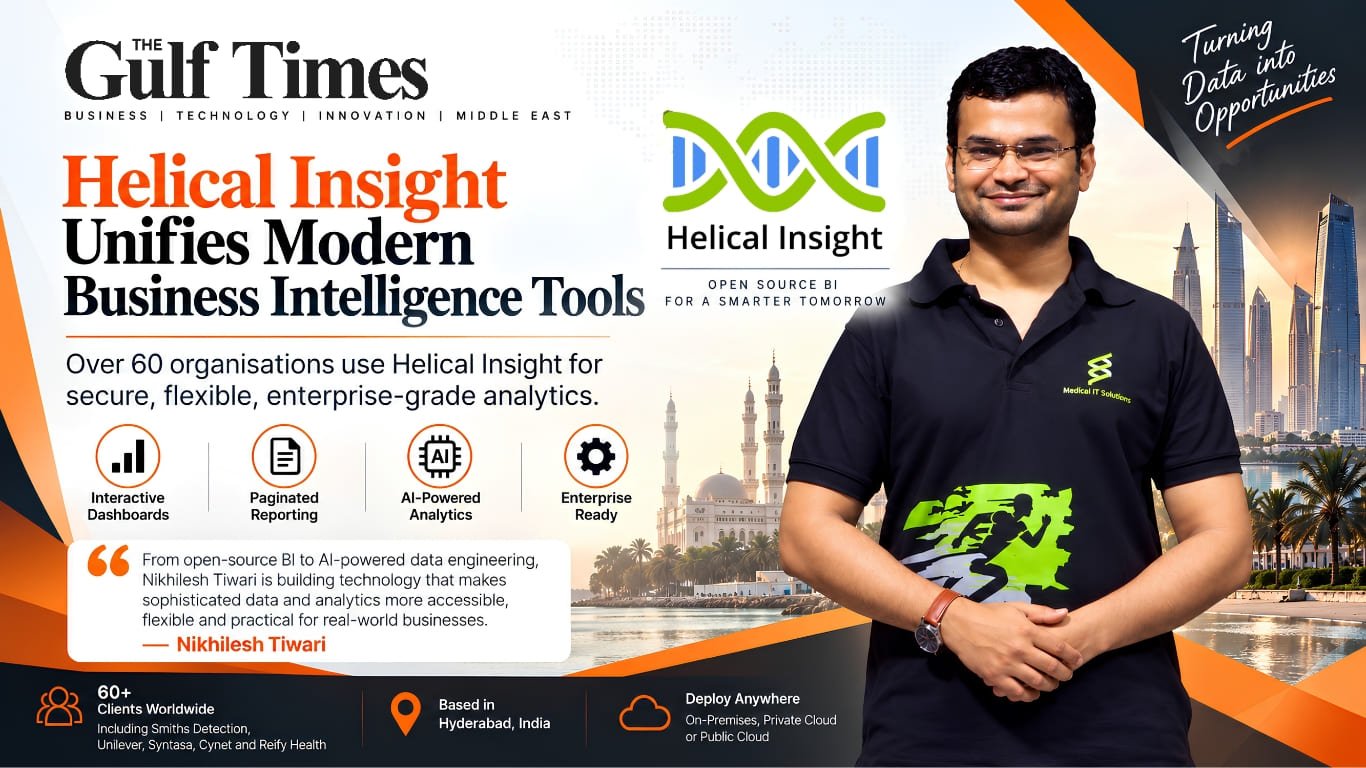
As companies around the world rush to add artificial intelligence to their operations, a quieter question is gaining weight in boardrooms: who controls the data, the infrastructure and the model? For organisations handling sensitive business information, the answer can decide whether an AI project is approved or shelved.
It is a question that Nikhilesh Tiwari, co-founder of Hyderabad-based Helical IT Solutions, has built a product around. Helical Insight is an open-source business intelligence and analytics platform that organisations can run on their own servers or in the cloud of their choice, and that lets them bring their own large language model rather than adopt a single vendors AI. After a recent decision to make its full functionality free, it is drawing a growing community of developers and attention from technology media.
For enterprises and startups in the Gulf and other markets weighing analytics and AI investments, the approach offers a useful case study in control, flexibility and cost.
From Hyderabad to a global client base
Nikhilesh Tiwari co-founded Helical IT Solutions in October 2012, starting with open-source data warehousing and business intelligence work. Since then, the company has served clients across domains and geographies, from analytics firm Fractal Analytics and telecom major Tata Communications to engineering group Technip and the Government of Micronesia.
Its product, Helical Insight, was co-founded in 2016 as an open-source BI framework. According to Tiwaris professional profile, more than 60 organisations use it, including Smiths Detection, Unilever, Syntasa, Cynet and Reify Health. Working with customers in different countries has taught the team a practical lesson: every organisation has different data sources, security requirements, reporting formats, deployment models and integration needs.
Working closely with customers helped us prioritize features based on real-world problems rather than simply following industry trends, Tiwari says.
Control is the new currency
The pitch rests on three layers of control: over data, over infrastructure and over AI.
On infrastructure, Helical Insight can be deployed on-premises, in a private cloud or in public cloud environments, including Docker and Kubernetes setups. For organisations with data-residency, privacy or compliance requirements, running analytics inside their own environment is often a precondition rather than a preference.
On data, the platform includes row-level security and role-based access to govern who sees which records, single sign-on to connect with existing identity systems, and multi-tenancy so that one installation can
serve several customers or business units. White labelling lets the analytics appear under a customers own brand.
On AI, the platform takes a different path from many competitors, and it is the part most likely to interest executives planning their next technology budget.
Bring your own AI
Helical Insight offers conversational analytics, allowing users to ask questions about their data in natural language and receive meaningful analysis instead of learning a complex BI interface. The companys approach is bring-your-own-LLM: organisations connect the AI model that suits them, or use models inside their own environment.
Tiwari explains the reasoning. Many AI analytics products are closely tied to their own models or cloud ecosystems, and he believes organisations should have more choice and control over which AI models they use, particularly when dealing with sensitive business data.
In practice, that means a company can align its analytics with its own security and compliance requirements, rather than accepting a single ecosystems terms. It also leaves room to change models as the technology moves. Looking further ahead, Tiwari expects users to ask follow-up questions, discover trends, generate analyses and eventually rely on AI agents to assist with parts of the analytics workflow.
Open source as a global distribution engine
Helicals most consequential strategic move was to remove the paywall. The company now includes AI analytics, dashboards, paginated reports, embedding, security, SSO and multi-tenancy in its free Community Edition, ending the traditional open-core model in which important enterprise features sit behind paid tiers. Within a month of the change, the projects GitHub repository crossed 1,000 stars and 700 forks.
For a company based in India with ambitions abroad, open source works as a distribution channel that needs no local sales office. A developer in any city can download the software, inspect the code, test it against real data and decide whether it fits before any conversation with sales. Tiwaris goal, he says, is a genuinely open platform that developers and organisations can inspect, use, customize, contribute to, and deploy themselves.
The projects forum, documentation and video guides support that community, and a partner programme spanning channel, solution and OEM partners extends its reach. Coverage from MarTech Series, AI Weekly, The Executive Outlook and Open Source For You magazine has added visibility around the release of version 7.0.
What it means for businesses and startups
- Large enterprises can consolidate dashboards, pixel-perfect reporting, embedded analytics and AI into one platform, and choose where it runs.
- Regulated organisations can keep data and infrastructure in-house while still adopting conversational AI, by connecting a model they control.
- Startups and SMEs can access enterprise-grade analytics without per-user licence fees, which can be a real barrier for smaller budgets.
- Software and platform companies can embed white-labelled, multi-tenant analytics into a learning platform, SaaS product, fintech application or ERP.
The next chapter: AI for data engineering
Tiwaris ambitions do not stop at BI. In January 2024 he co-founded Ask On Data, which applies natural-language processing and AI to the technical work of data engineering. Users build data pipelines through a
chat interface, handling tasks such as data cleaning, loading, transformation, migration and integration without writing code.
The company describes the product as the worlds first NLP-based data engineering tool, and it emphasises data security, stating that it does not simply outsource the work to general-purpose tools such as ChatGPT. The pitch mirrors Helical Insights: remove the barriers that keep powerful data technology in the hands of a few specialists, and keep customers in control of their information.
The hard road to global credibility
Tiwari does not pretend that the journey has been easy. Building an enterprise-grade BI product in a market dominated by large, established platforms demands strong security, reporting, embedding, scalability, integrations and support, and doing so under an open-source model requires time, engineering effort and persistence.
There was also a perception problem. Many organisations assume that open source means basic functionality and that serious features will eventually cost extra. Helical has worked to change that view through customer implementations and continuous product development. And with BI evolving from traditional reporting to self-service analytics, embedded BI, cloud deployment and now AI, the team has kept expanding a single platform rather than launching separate products.
The five-year goal
The long-term vision is for Helical Insight to become a globally recognised free and open-source platform for business intelligence, analytics and AI-driven data exploration. Over the next five years, Tiwari wants to expand the companys global presence, build a much larger developer and user community, and grow adoption across enterprises and startups.
The business model will stay rooted in enterprise support, implementation, customisation, training and related services, not in restricting the free product. We dont want to simply build another BI tool, he says. The ambition is a more open analytics ecosystem in which organisations have greater control over their data, infrastructure, AI models and technology choices.
Advice from the founder
Tiwaris guidance for aspiring entrepreneurs is grounded in his own experience. Solve a real problem rather than simply trying to build a company, and spend time understanding what customers are doing today.
Think long term, because there will be periods of slow growth and strong competition. Do not assume that the conventional business model is the only one. And do not wait for everything to be perfect: build something, put it in front of real users and keep improving.
The journey is rarely linear, he says, but consistency and the willingness to adapt can be more valuable than having everything figured out on day one.
To connect with their team :
Visit their website : https://www.helicalinsight.com
Company LinkedIn : https://www.linkedin.com/showcase/helical_insight/
Nikhilesh Tiwari’s LinkedIn: https://www.linkedin.com/in/nikitiwari/
Story Featured by The Gulf Times.