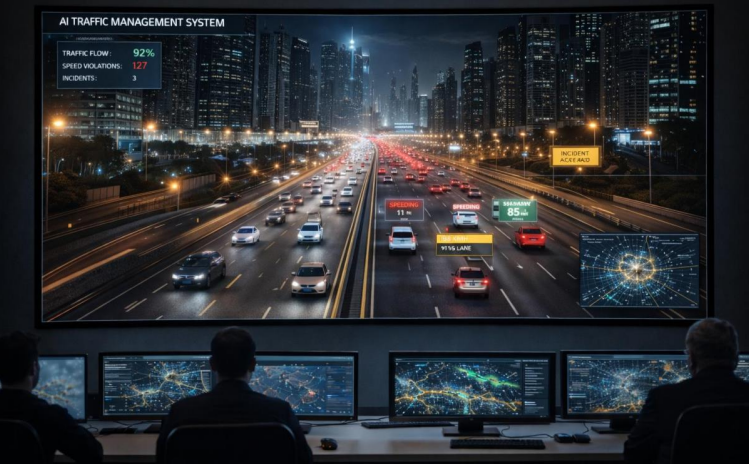
The Dubai Police today announced the launch of a comprehensive Dubai AI Traffic safety programme, marking a significant step in the emirate’s push toward fully intelligent urban mobility systems. The initiative, unveiled during an official briefing by senior law-enforcement and mobility officials, aims to improve road safety, optimise traffic flow and reduce accident rates across high-density transport corridors. Authorities confirmed that citywide rollout has already begun with the deployment of advanced AI sensors, real-time analytics platforms and automated enforcement tools.
The announcement was accompanied by early operational data from trial runs conducted over recent months, showing measurable reductions in speeding violations and a 12 percent improvement in peak-hour signal efficiency. Officials identified the programme as part of Dubai AI Traffic Safety broader strategy to integrate AI into public services by 2030, positioning the emirate as a global leader in smart mobility innovation.
AI System Capabilities and Deployment Strategy
The newly launched system uses a network of machine-learning algorithms developed to analyse live traffic feeds, monitor vehicle movement patterns and detect speeding, tailgating or dangerous lane changes. According to Dubai AI Traffic Safety Police engineers, the AI models have been trained on millions of mobility data points collected from varied traffic conditions across the emirate, enabling predictive analysis and automated decision-making.
Deployment began earlier this week across critical routes including Sheikh Zayed Road, Al Khail Road and major arterial networks connecting commercial districts. Early implementation phases focus on improving signal timing accuracy and reducing collision-prone bottlenecks. Officials reported that the system integrates seamlessly with existing smart infrastructure and emergency-response operations, enabling faster dispatch times during high-risk incidents.
Enforcement Enhancements and Road Safety Impact
One of the most notable features of the programme is its enhanced enforcement capability. The AI system automatically flags repeat traffic offenders, issues electronic warnings and can initiate penalties based on automated detection validated by human supervisors. Dubai AI Traffic Safety Police confirmed that smart surveillance towers along highways now integrate advanced recognition technology designed to strengthen compliance and discourage dangerous driving behaviours.
Early assessments indicate that the technology has improved overall response efficiency. In pilot zones where the system was active for the last three months, authorities observed a drop in high-speed violation clusters and a significant decrease in tailgating incidents, historically one of the leading causes of multi-vehicle collisions. Officials noted that the wider rollout is expected to produce measurable safety improvements across the entire emirate before mid-2026.
Infrastructure Integration and Technology Partnerships
The programme is being implemented in partnership with regional and international technology firms specialising in AI signal optimisation, cloud-based analytics and sensor integration. Engineers confirmed that Dubai AI Traffic Safety existing intelligent transport infrastructure allows seamless linkage between AI systems and on-ground traffic controllers, enabling automated adjustments during congestion surges, road works or emergency diversions.
Infrastructure planners said the initiative aligns closely with the emirate’s long-term mobility strategy, which emphasises resilient road networks and sustainable transport innovation. The AI ecosystems will also integrate with multi-modal systems involving public transit, autonomous-vehicle corridors and logistics routes, allowing the city’s transport authorities to forecast congestion patterns and plan long-term investments more effectively.
Public Communication and Future Expansion Phases
Dubai Police stated that public awareness campaigns will begin next week to inform residents about the new AI-driven regulations, compliance expectations and safety protocols. Officials emphasised that the technology is intended to enhance not replace human oversight, and that officers will continue to play a critical role in complex traffic management scenarios. Training sessions for field officers have already been conducted to familiarise them with the system’s operating framework.
Future phases of the programme include expanding AI sensors to residential neighbourhoods, school zones and commercial districts, along with deploying predictive modelling tools that anticipate accident hotspots up to 24 hours in advance. Authorities also indicated that the system may be integrated with weather-based forecasting models to improve decision-making during fog, sandstorms and seasonal climate events affecting visibility and road safety.
Conclusion
Dubai AI traffic safety programme marks a transformational moment in the city’s public-safety infrastructure. With advanced analytics, predictive modelling and automated enforcement, the initiative represents a decisive shift toward data-driven urban governance aimed at protecting residents and enhancing long-term mobility planning.
As the programme expands over the coming months, officials expect to see substantial reductions in accident rates and improved traffic management efficiency. The initiative reinforces Dubai’s position as a regional leader in adopting next-generation technologies, setting a benchmark for smart-city development across the Middle East.