Growing Public Concern over Immigration
UK immigration tensions has once again become one of the most pressing political issues in the United Kingdom, as large public protests highlight deep divisions across society. Despite recent data showing that net migration figures are beginning to fall, opinion polls consistently reveal that a majority of Britons still view immigration as one of the country’s top concerns. The debate is being shaped not only by policy reforms but also by visible demonstrations and mounting criticism directed at the government from multiple sides.
Many communities have expressed frustration over the government’s use of hotels to house asylum seekers, which they argue places pressure on local services and fuels public resentment. Critics say that the government’s management of accommodation has created flashpoints, while officials defend the approach as a necessary short-term solution in the face of rising asylum applications.
Anti-Immigration Protests Highlight Divisions
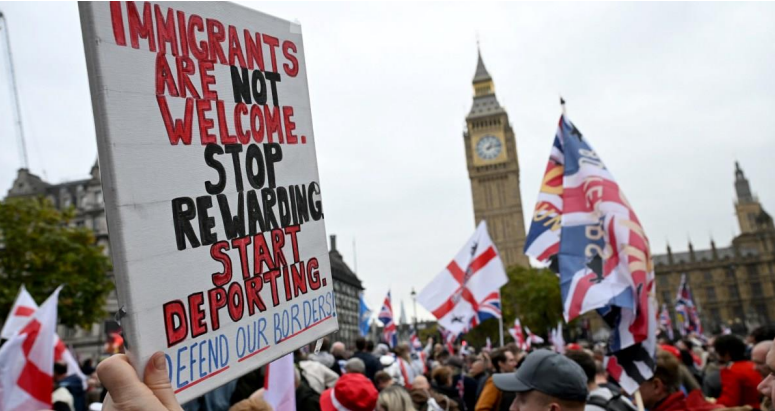
One of the most notable demonstrations, the “Unite the Kingdom” march, brought tens of thousands of protesters to the streets in recent weeks. The march was largely directed against the government’s handling of asylum seekers and its perceived failure to reduce illegal Channel crossings. Demonstrators carried banners calling for tougher border controls and a complete end to the use of taxpayer-funded hotel accommodation.
Organizers of the protest argue that ordinary Britons are being ignored while resources are diverted to migrants. The march also attracted support from some right-leaning political groups, who have vowed to make immigration a central issue in the run-up to the next general election. At the same time, counter-protest groups and human rights campaigners condemned the rallies as fostering hostility toward vulnerable people fleeing war and persecution.
Government Defends Its Immigration Policies
The Labour government, led by Prime Minister Keir Starmer, has emphasized that steps are being taken to regain control over the immigration system. The recently introduced “one-in, one-out” migrant returns deal with France, aimed at reducing small boat crossings in the English Channel, marks a significant shift in bilateral cooperation.
Under the scheme, for every asylum seeker Britain accepts from France, the UK immigration tensions is allowed to return one who arrived via an illegal Channel crossing.
However, the rollout has faced immediate legal challenges. High Court injunctions have already delayed some deportations, with lawyers citing potential breaches of human rights law and protections for victims of modern slavery. Home Secretary Shabana Mahmood has called these interventions “last-minute blocks” that undermine the effectiveness of the government’s strategy. She has also signaled that the Modern Slavery Act could be reviewed to prevent what ministers see as exploitation of legal loopholes.
Political Pressure from All Sides
The immigration debate is placing significant strain on the government’s political standing. While opposition parties such as the Conservatives and Reform UK immigration tensions accuse Labour of being too soft on illegal migration, human rights groups and some Labour backbenchers argue that the government risks breaching international obligations by prioritizing removals over protections.
The Immigration White Paper published earlier this year has also drawn attention for proposing stricter settlement rules, higher English language requirements, and reduced sponsorship opportunities for foreign workers. While ministers claim these measures will restore public confidence, business leaders and unions warn they could harm sectors such as health care, hospitality, and social care that rely heavily on migrant labor.
Public Opinion and the Road Ahead
Public opinion remains firmly divided. While many citizens demand tougher border enforcement and reductions in immigration numbers, others call for a more compassionate approach that safeguards Britain’s reputation as a country committed to human rights and international law.
The visible protests across major cities underscore how immigration has become not only a policy challenge but also a cultural and political flashpoint.
As the government prepares further reforms to asylum processing, accommodation, and deportation rules, the pressure from both sides of the debate is expected to grow. With the next election cycle drawing closer, immigration is almost certain to remain a dominant issue in UK immigration tensions politics—one that will test the government’s ability to balance control, compassion, and compliance with international commitments.