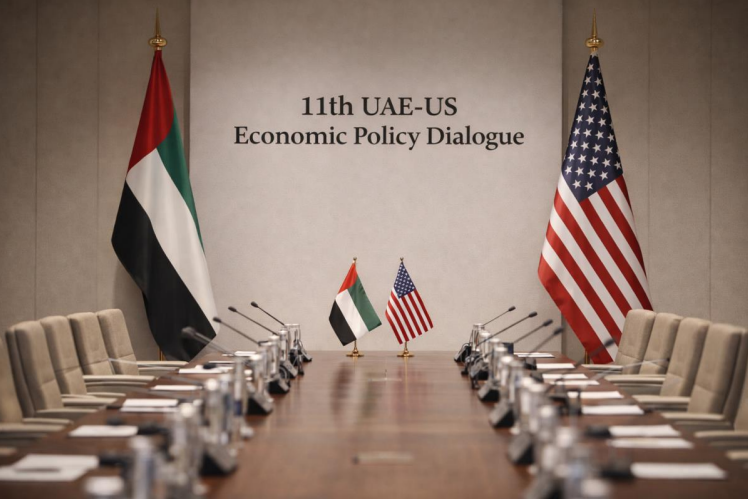
The United Arab Emirates and the United States convened the 11th round of the UAE–US Economic Policy Dialogue in Abu Dhabi, reaffirming one of the region’s most significant bilateral partnerships in trade, investment, energy transition and technological cooperation.
Senior officials from both nations met to review progress on existing initiatives and outline new frameworks for strengthening economic ties amid a shifting global financial landscape. The UAE–US Dialogue, established over a decade ago, has become a central platform for institutional coordination between the two countries, which now maintain one of the Middle East’s most robust strategic and commercial relationships.
Deepened Bilateral Trade and Investment
The meeting was led on the UAE side by senior representatives from the Ministry of Economy and the Ministry of Finance, while the U.S. delegation included officials from the Department of State, Department of Commerce and the Office of the U.S. Trade Representative.
Both teams highlighted the resilience of bilateral economic engagement, noting that non-oil trade between the UAE and U.S. exceeded USD 31 billion in 2024, making the UAE the United States’ largest export market in the Middle East for 15 consecutive years.
Officials reviewed sectoral performance from the past two years and underlined the growing importance of digital trade, advanced industries and food security partnerships. Discussions also focused on expanding U.S. foreign direct investment in the UAE, with U.S. companies currently operating more than 1,500 regional offices in the country, one of the highest such concentrations globally.
A senior UAE official stated during the opening session that “the UAE–US partnership remains central to our diversification strategy and continues to provide a platform for joint innovation, capital mobility and sustainable growth.”
Energy Transition, Climate Cooperation and Clean Tech Partnerships
Energy and climate cooperation formed one of the central pillars of the 11th UAE–US Dialogue. Both sides reviewed ongoing work under the UAE–US Partnership for Accelerating Clean Energy (PACE), launched in 2022 with a combined financing goal of USD 100 billion in clean energy projects by 2035.
Representatives discussed progress on hydrogen production capabilities, carbon capture models and renewable energy expansion in both domestic and third-country markets.
The UAE delegation presented updates on national energy projects contributing to its Net Zero by 2050 Strategic Initiative, including solar capacity expansions at Al Dhafra and Mohamed bin Rashid Solar Park.
U.S. officials emphasized the rising appetite among American companies for green investment opportunities in the Gulf, citing ongoing collaboration with UAE firms in battery storage, modular reactors and climate-focused venture capital.
Participants highlighted that the UAE–US energy partnership has gained global relevance following COP28, where the two nations jointly backed commitments to triple renewable energy capacity and double energy efficiency improvements worldwide.
Technology, Digital Trade and Artificial Intelligence Agreements Advance
A major focus of this year’s dialogue revolved around the acceleration of technology and digital economy cooperation. Both countries acknowledged surging bilateral activity in data infrastructure, cybersecurity, cloud services and artificial intelligence deployment.
The UAE’s rapidly growing digital sector valued at over USD 19 billion in 2025 was highlighted as an area of major strategic interest for U.S. firms seeking regional expansion.
Discussions covered regulatory alignment on digital trade standards, secure data transfer frameworks, and the integration of American tech companies in the UAE’s smart-city and AI transformation programs.
U.S. officials expressed strong interest in deepening commercial integration with Abu Dhabi’s technology clusters, including initiatives connected to advanced manufacturing, space technology and semiconductor development.
Joint working groups were assigned to accelerate pilot projects in AI governance, quantum research collaboration and digital payment interoperability.
Strengthening Financial, Tax and Regulatory Cooperation
The UAE–US Dialogue also reviewed bilateral financial and regulatory coordination mechanisms, including progress under the UAE–US Terrorist Financing Working Group, the FATF Action Plan, and joint tax cooperation programs.
Both sides reiterated the importance of compliance, transparency and modernized financial frameworks in maintaining stable investor confidence.
Macro-economic discussions included inflation trends, supply chain resilience and fiscal modernization. The UAE presented updates on its ongoing corporate tax framework rollout, while the U.S. delegation outlined updates on international taxation developments and regulatory reforms affecting global businesses.
Both parties expressed interest in developing mechanisms to enhance investment protection and support for small and medium enterprises, particularly in logistics, healthcare technology, agritech and cross-border fintech operations.
Conclusion
The 11th UAE–US Economic Policy Dialogue underscored the breadth and maturity of the bilateral partnership spanning energy cooperation, advanced technology, investment integration and policy coordination.
As both countries navigate evolving global economic conditions, the UAE–US Dialogue serves as a strategic anchor ensuring sustained alignment and shared opportunity.
Officials from both nations described this year’s talks as “highly productive,” noting that several working groups will reconvene over the coming months to convert policy discussions into actionable programs.
With the UAE preparing for major diversification milestones in 2026 and the United States focusing on expanding its economic reach in high-growth regions, both countries emphasized that the UAE–US Dialogue will continue to play a pivotal role in steering long-term cooperation and ensuring commercial stability across vital sectors.