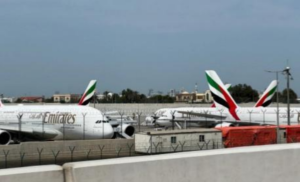
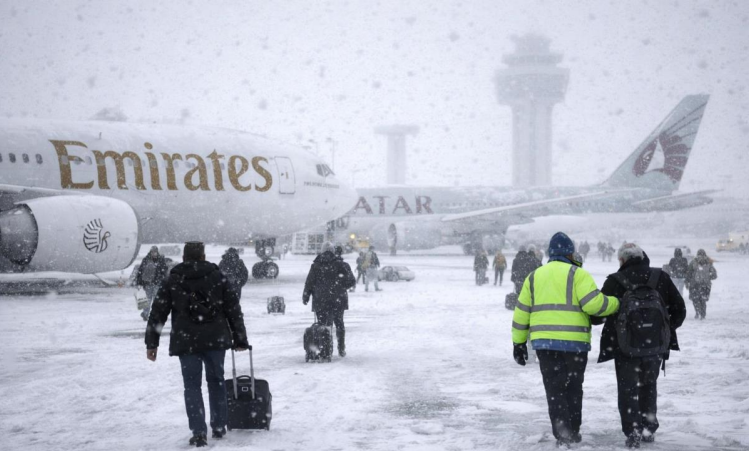
Air travel between the Gulf and the United States faced extensive disruption for a third consecutive day as a powerful US Winter Storm continued to sweep across the eastern and northeastern United States. With widespread snow accumulation, icy conditions, and airport shutdowns from New York to Boston, major carriers including Emirates, Etihad, Qatar Airways and multiple U.S. airlines were forced to cancel, divert or heavily delay flights, leaving thousands of passengers stranded across transit hubs.
Severe Storm Forces Widespread Airport Closures Across the U.S.
The storm, described by the U.S. National Weather Service as one of the strongest January systems in a decade, brought wind speeds exceeding 80 km/h and snow accumulation crossing 30–45 cm in several states.
Major airports including John F. Kennedy International Airport, Newark Liberty International Airport, Boston Logan International Airport and Philadelphia International Airport temporarily suspended operations from late January 25 to the morning of January 27 due to unsafe runway conditions and near-zero visibility.
More than 3,200 flights were cancelled and over 6,800 were delayed within the US Winter Storm in a 48-hour period. Long-haul operations from the Gulf region were directly impacted, particularly services scheduled to arrive during peak storm hours.
In a statement issued early January 27, U.S. aviation authorities confirmed that “airport reopening timelines will depend on clearing operations, weather stabilization and crew availability,” indicating that delays are likely to continue for at least another 24 to 36 hours.
Announcements of Rolling Delays and Cancellations
Gulf carriers, which operate some of the world’s busiest transcontinental routes, were among the hardest hit. Emirates confirmed that several New York, Boston and Washington D.C. flights scheduled between January 25–27 were either cancelled or rescheduled due to runway closures and severe weather patterns over the northeastern United States.
Etihad Airways also announced delays of up to 10–14 hours on key U.S.-bound flights, while some return services to Abu Dhabi were forced to remain grounded until airports reopened.
Qatar Airways, which connects passengers through Doha to various American hubs, issued advisories noting operational disruptions to Chicago, New York and Philadelphia routes.
Airline officials said they were prioritizing rebooking and accommodation assistance. An Emirates spokesperson stated, “Safety remains our highest priority. All operational decisions are being taken in coordination with airport authorities in the United States to ensure safe arrivals and departures once weather conditions improve.”
Passenger load factors on Gulf–US Winter Storm routes remain high in January due to holiday travel and student relocation, intensifying the impact of the sudden disruption.
Ripple Effect: Passengers Stranded Across Gulf Airports
The delays created crowding at major Gulf airports including Dubai International Airport, Abu Dhabi International Airport and Hamad International Airport, where transit passengers were unable to complete onward journeys.
Temporary accommodation had to be arranged for long-haul travelers, particularly those arriving from Asia and Africa with connecting flights to the United States.
Several passengers reported being rebooked onto flights 24–48 hours later due to aircraft rotation issues and limited crew availability.
Airport hospitality desks in Dubai and Doha extended meal vouchers, hotel stay arrangements and assistance with travel documentation changes.
Local authorities recorded a spike in inquiries related to visa extensions and revalidation of travel bookings. Tourism and hospitality operators reported increased last-minute hotel stays as stranded travelers waited for weather-dependent confirmations.
Operational and Economic Impact on Gulf Carriers
The storm’s effect on long-haul scheduling has created a significant operational challenge for Gulf carriers. Extended flight rotations, aircraft repositioning delays and increased fuel and crew costs for diversions are expected to carry measurable financial implications.
Airline industry analysts noted that January typically marks a high-demand period for transcontinental travel. Extended weather disruptions during this window can result in costly cascading effects on fleet management.
Flights that are cancelled or delayed by more than 12 hours generally require complete operational resets, from crew duty-hour compliance to passenger re-accommodation across multiple service classes.
Economic experts estimate that the combined disruptions for Gulf-based airlines over three days could exceed USD 12–18 million in operational and passenger-care costs, excluding longer-term scheduling adjustments.
Estimated Further Delays
Meteorological reports indicate that the current winter system could generate additional snow bands moving across the northeastern corridor, potentially affecting flight operations into late January 28.
U.S. aviation officials have issued cold-weather advisories and cautioned that even when runways reopen, a significant backlog of flights will need to be cleared before normal schedules resume.
Gulf carriers have advised passengers to check revised flight timings regularly and avoid arriving at airports early unless instructed.
Airport authorities in the UAE and Qatar emphasized that they are working closely with US Winter Storm counterparts to restore normal operations but warned that full recovery could take an additional 24–48 hours depending on weather progression.
Conclusion
The sustained US Winter Storm in the United States has caused one of the most significant disruptions to Gulf–U.S. air travel in recent months, affecting thousands of travelers and forcing major carriers to delay or cancel critical long-haul routes.
With safety protocols and weather-driven restrictions remaining the top priority, Gulf airlines continue to adjust operations in real time. As both Gulf and U.S. authorities work to restore normal traffic flow, passengers are advised to remain updated through airline alerts, as the operational impact of this storm is likely to extend into the coming days.
Gulf carriers are preparing contingency plans, including additional recovery flights and fleet adjustments, to minimize long-term disruptions. The event has highlighted the vulnerability of international aviation to extreme weather patterns, an increasingly frequent challenge that global airlines are being forced to navigate with stronger coordination and strategic resilience.