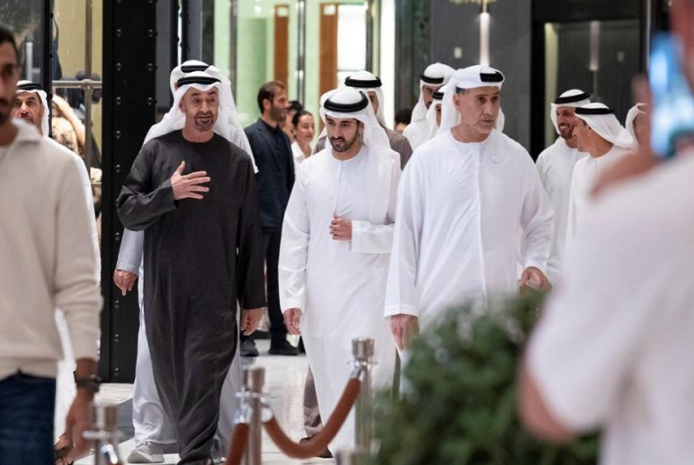
In a highly symbolic public appearance, UAE President His Highness Sheikh Mohamed bin Zayed Al Nahyan visited Dubai Mall accompanied by His Highness Sheikh Hamdan bin Mohammed bin Rashid Al Maktoum, Deputy Prime Minister and Minister of Defence. The visit, which took place on March 2, 2026, comes at a moment of heightened regional tensions following missile and drone attacks across multiple Gulf capitals. The UAE leadership stability presence in one of the world’s busiest commercial hubs served as a direct message to residents and the international community that the United Arab Emirates remains stable, secure and fully in control of the situation.
Eyewitnesses reported a calm and orderly atmosphere throughout the mall, with videos circulating widely on social platforms showing the President walking through public areas with minimal security barriers. Analysts note that the UAE leadership stability has historically embraced public visibility during periods of uncertainty, using symbolic gestures to anchor confidence in national security systems and demonstrate an unshaken sense of normalcy despite external pressures.
Leadership Presence Reinforces UAE’s Message of Stability
Officials and observers agree that the President’s visit was deliberately scheduled to reassure the nation. Public appearances by top UAE leadership stability are rare during high-alert periods, which made the outing especially significant. By choosing a crowded public venue instead of a controlled environment, the UAE leadership stability projected an image of full confidence in domestic safety and the readiness of its defence apparatus.
Residents who witnessed the visit reported a visible sense of relief and pride, with many describing the moment as a reminder of the UAE’s long-standing commitment to order and stability. In previous moments of geopolitical stress, including missile threats in 2022, public reassurance from the country’s leadership has consistently contributed to maintaining calm across the Emirates. The Dubai Mall appearance follows the same tradition, reinforcing the idea that daily life should continue without disruption.
The visit also countered speculation circulating online about security concerns in major cities. Analysts point out that symbolic gestures are critical in densely populated cosmopolitan hubs like Dubai, where confidence in public safety directly influences tourism, business activity and investor sentiment.
Occurrence Amid Heightened Regional Threat Environment
The leadership’s visit comes shortly after a series of missile and drone attacks launched from regional conflict zones, which impacted multiple Gulf capitals. While UAE officials confirmed that national air defence systems remain fully activated and at peak readiness, the decision to maintain openness at public venues demonstrates a strategic balance between vigilance and continuity.
The UAE’s defensive posture has been closely coordinated with regional and international partners, ensuring rapid interception capabilities and constant monitoring of aerial threats. Officials have repeatedly emphasised that while the region is undergoing a volatile period, the nation’s multi-layered defence systems are among the most advanced globally, giving the government strong confidence in civilian protection.
Despite regional escalation, transportation systems, shopping districts, hospitality zones and public attractions across Dubai and Abu Dhabi have continued to operate without restrictions.
Authorities note that maintaining civilian routines is an essential part of the UAE’s approach to resilience during geopolitical crises.
Public Reassurance Becomes Strategic Response
Public behaviour across the UAE remained largely unchanged following reports of regional attacks. The leadership’s presence at Dubai Mall amplified this calm, reassuring residents, expatriates and tourists that the Emirates remains safe. The symbolic gesture also acted as a counter-narrative to regional panic, reinforcing the UAE’s longstanding reputation as a haven for security and stability.
Social sentiment across platforms reflected this reassurance, with observers noting admiration for the leadership’s visibility. In contrast to other regions where leaders may retreat to secure sites in times of tension, the UAE’s public approach strengthens trust in government and showcases the country’s model of transparent, composed governance.
International analysts observed that such gestures also support economic stability. Tourism, retail spending and business activity are sensitive to perceptions of risk, and leadership appearances in public spaces help maintain investor confidence at critical moments. Dubai Mall, being a central symbol of the UAE’s global economic stature, provided an ideal backdrop for this message.
International Partners Briefed as UAE Coordinates Diplomacy
In parallel with the public assurance strategy, the UAE has engaged in active diplomatic communication with global partners, including discussions with several allied nations about regional developments. The leadership has reiterated the UAE’s commitment to de-escalation, balanced diplomacy and coordinated responses to emerging threats.
International partners have acknowledged the UAE’s calm and strategic approach, commending its combination of defensive readiness and diplomatic outreach. Analysts note that the UAE’s measured behaviour not only strengthens internal stability but also positions it as a responsible regional actor at a time of broader Middle Eastern uncertainty.
These diplomatic efforts, coupled with public statecraft gestures like the Dubai Mall visit, create a multi-dimensional strategy blending security assurance, public confidence-building and international alignment. Together, they underline the UAE’s broader posture: firm, prepared and committed to protecting its people without compromising normal life.
Broader Implications for Civil Society and Economic Confidence
The UAE’s social fabric is closely integrated with its economic ecosystem, and public displays of leadership during tense moments help reinforce unity and collective calm. The presence of the President and Defence Minister in a bustling public venue demonstrates to residents that civil society continues unhindered, supported by a robust security infrastructure that operates seamlessly in the background.
Economists highlight that the UAE’s economic sectors including retail, aviation, hospitality and finance depend significantly on perceptions of safety and operational continuity. UAE leadership stability visibility signals to investors that the domestic environment remains stable, preventing anxiety-driven economic reactions such as travel cancellations, reduced consumer spending or short-term capital withdrawal.
As the region navigates heightened tensions, the UAE’s balanced combination of defence preparedness, public reassurance and diplomatic engagement offers a stabilising anchor for both residents and regional observers. The Dubai Mall visit stands as a carefully timed demonstration of calm leadership during a period of regional volatility.