Across cultures and calendars, 2026 is often described as a year of heightened momentum. In the Chinese zodiac, it marks the rare Year of the Fire Horse a once-in-60-years cycle associated with decisive action, transformation, and accelerated change. In other traditions, it is viewed as a “Sun Year,” symbolising clarity, energy, and forward motion.
While such interpretations are cultural rather than predictive, they mirror today’s business reality. As organisations enter 2026, they face regulatory complexity, geopolitical uncertainty, rapid digital transformation, and rising expectations from boards and regulators. In this environment, Integrated Risk Management (IRM) can no longer remain a background function—it is becoming a leadership discipline.
Periods of acceleration test organisations in unique ways. Decisions are made faster, transformation initiatives run in parallel, and risk exposure increases not because controls are weak, but because the pace of change introduces complexity. Emerging risks are often overlooked simply because attention is fragmented.
From my experience building GRCxperts over the past several years, one lesson is clear: momentum without governance creates fragility, while governance without momentum creates stagnation. Effective IRM leadership lies in balancing both.
The Real Challenge Is Execution
Most organisations today are more aware of their risks than ever before. What continues to challenge them is execution at scale.
IRM initiatives often begin with clarity and intent, but over time struggle with fragmented ownership across regions, inconsistent execution between global and local teams, and limited adoption beyond risk and compliance functions. This is not a failure of strategy it is a failure of operating models.
IRM must be designed as a continuous journey, not a one-time initiative. Especially during high-growth or transformation phases, risk frameworks must move at the same pace as the business.
Culturally, the Fire Horse symbolises courage and decisive leadership. In business terms, 2026 demands similar qualities—grounded in responsibility rather than impulse. Leaders who succeed with IRM typically focus on three priorities: clarity of intent beyond compliance, consistency of execution across geographies, and continuity of ownership as the business evolves.
IRM maturity is ultimately a reflection of leadership maturity.
Scaling with Purpose
At GRCxperts, our own growth journey has reinforced this belief. Expansion whether geographic or organizational creates value only when it strengthens execution discipline. Purposeful scale is about depth, not dilution; capability, not complexity.
This mindset shapes how we approach cross-regional IRM programmes: establishing consistent governance principles while empowering local teams with ownership. It is this balance that allows organisations to move quickly and remain in control.
Looking Ahead
Whether viewed through cultural symbolism or business reality, 2026 is shaping up to be a defining year. Momentum is unavoidable. The question is whether it will be harnessed or allowed to overwhelm existing structures.
A regional CEO of a fast-growing multinational once captured this challenge succinctly. Despite strong growth and expansion, his board struggled to answer a simple question: “What could realistically surprise us in the next six months?” Risk signals were present, but fragmented.
By reframing risk management as a leadership and decision-support discipline clarifying ownership and connecting early warning signals the organisation gained confidence without slowing down. As the CEO later observed, “Risk management didn’t reduce our momentum; it removed uncertainty from it.”
In years of transformation, clarity matters more than caution. For leaders willing to treat IRM as a strategic capability rather than a compliance obligation, today’s environment offers an opportunity to build organisations that are not only fast-moving but fundamentally resilient.
About the Author
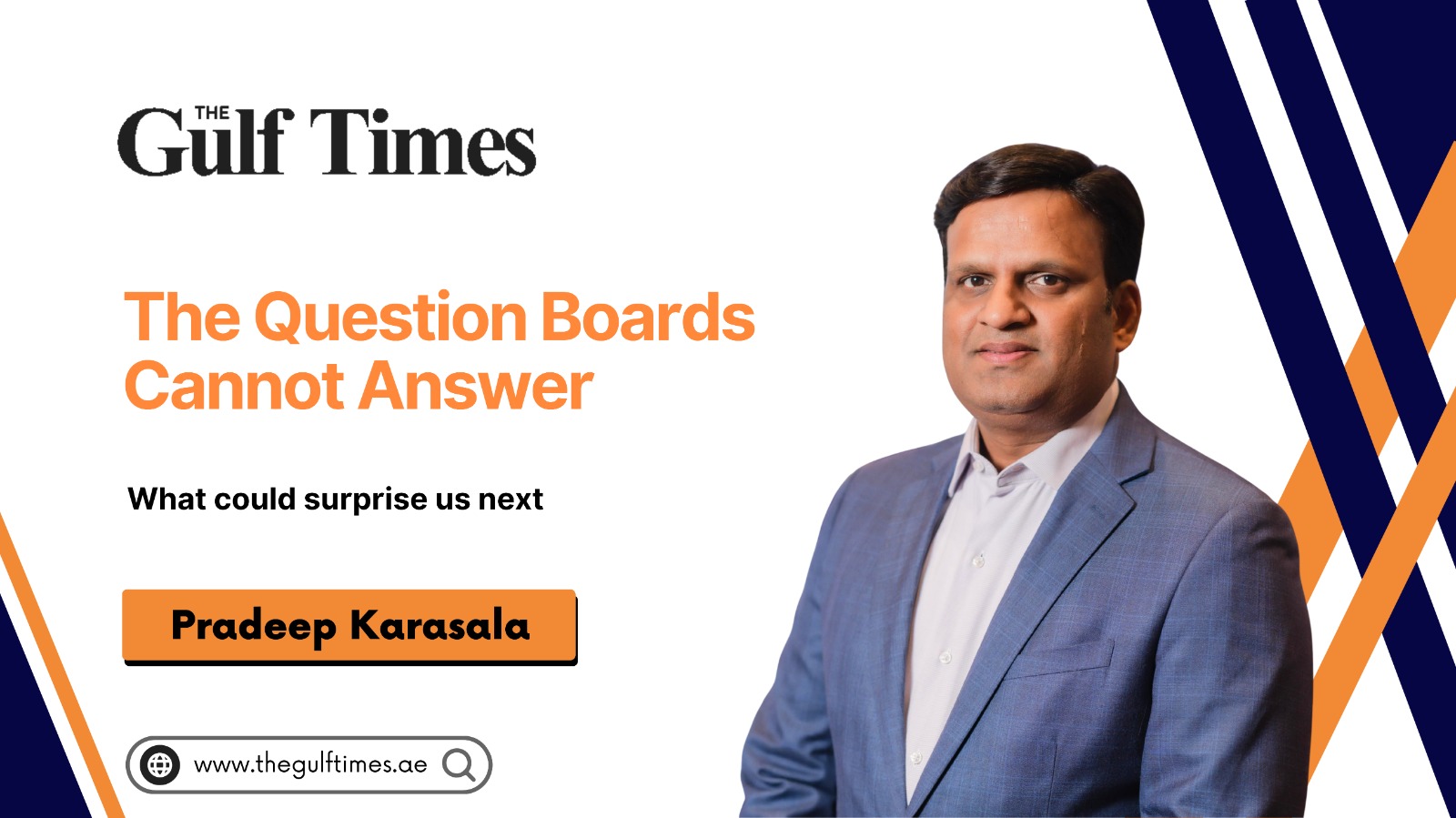
Pradeep Karasala is Founder & CEO of GRCxperts, headquartered in Dubai, UAE. To expand its global footprint, GRCxperts recently acquired Governify, a Europe-based firm. Pradeep is a recognised thought leader in Governance, Risk & Compliance and can be reached at pradeep@grcxperts.com.