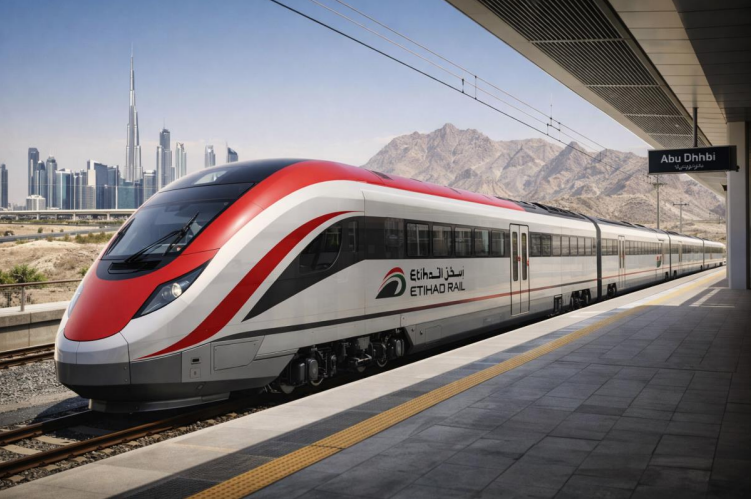
The United Arab Emirates is on the verge of a transformative shift in national transportation as Etihad Rail Network prepares to launch its first passenger rail services in 2026, linking major cities across the federation and marking a landmark milestone in the country’s infrastructure development. After years of phased construction and testing, the nation’s integrated rail network initially planned primarily for freight will begin serving passengers in what is expected to be a game-changer for mobility, economic growth, and regional connectivity.
The passenger rail launch is scheduled to begin in phases during 2026, with the first services operating between Abu Dhabi, Dubai and Fujairah, forming the backbone of the new national network. The full network will eventually stretch across all seven emirates, linking 11 cities and regions via a route spanning roughly 900 kilometres. This ambitious transport project represents the culmination of decades of planning and investment aimed at redefining travel across the UAE and supporting broader economic diversification and sustainability goals.
From Vision to Reality: The Etihad Rail Journey
Etihad Rail was established as part of the UAE’s long-term infrastructure vision and economic development strategy, aimed at unifying the country’s disparate transport corridors into a cohesive national system. The project began with freight operations, which became fully operational in 2023, transporting cargo across strategic industrial and logistics hubs. That success laid the groundwork for the transition to passenger services.
Construction of the national rail network expanded rapidly from 2020 onwards, culminating in a rail infrastructure that connects the western border near Saudi Arabia at Ghuwaifat with the eastern port city of Fujairah on the Arabian Gulf. With the backbone network complete, Etihad Rail Network has focused on outfitting stations, testing rolling stock and preparing operational frameworks for passenger services.
This approach underscores a long-term commitment by UAE leadership to integrate modern public transport solutions into national economic planning. The rail network not only supports freight and logistics but also serves as a foundation for sustainable passenger mobility that will reduce dependence on road travel and improve overall travel efficiency between emirates.
Routes, Stations and Travel Times
The first phase of passenger services will include scheduled operations between the UAE’s major population and economic centres. Trains are expected to operate between Abu Dhabi and Dubai, with an approximate travel time of around 57 minutes to one hour, considerably faster than conventional road journeys. Services will extend to Fujairah on the east coast, with travel times of around 90 to 105 minutes depending on specific departure and stopping patterns.
Etihad Rail Network officials have confirmed the locations of initial stations, including:
- Mohammed bin Zayed City in Abu Dhabi
- Jumeirah Golf Estates in Dubai
- Sakamkam area near Fujairah
Additional stations will be opened in phases across the emirates, including Al Sila, Al Dhannah, Al Mirfa, Madinat Zayed, Mezairaa, Al Faya and Al Dhaid in Sharjah and Abu Dhabi. These routes were chosen to maximise connectivity and serve both urban and emerging communities.
The trains themselves will operate at speeds of up to 200 kilometres per hour and are designed for comfort and efficiency. Each train unit will accommodate up to 400 passengers across multiple classes of service, including economy, business and first class, ensuring a modern travel experience suited to both daily commuters and long-distance travellers.
Economic and Social Impact
The passenger rail network is expected to have far-reaching impacts on the UAE’s economy and society. By providing a reliable inter-emirate transport alternative, it will reduce road congestion, lower travel costs, and enhance labour mobility between key economic zones. The rail link is anticipated to support workforce movement, enabling residents and workers to access employment opportunities across emirates with greater ease and speed.
Analysts project significant economic benefits resulting from faster, more efficient transport. The rail network is expected to support increased tourism flows, particularly linking cultural, commercial, and coastal destinations, while also promoting regional investment initiatives and mixed-use developments around station hubs.
Moreover, the UAE’s emphasis on sustainability is reflected in the Etihad Rail Network project. The passenger rail system will contribute to reduced carbon emissions by shifting a portion of travel demand from road to rail, aligning with national environmental goals and international climate commitments. Planners estimate that the reduction in road traffic could eliminate millions of tonnes of CO₂ emissions annually once the network is fully operational.
The rail infrastructure will also enhance integration with other transport modes, including connections to buses, taxis and feeder services, ensuring seamless first- and last-mile connectivity for passengers.
Operational Framework and Future Prospects
Etihad Rail’s passenger services will roll out in phases throughout 2026 and beyond, with each stage introducing new routes and station operations. Officials emphasise that the phased approach ensures operational reliability while accommodating future expansions and technological upgrades.
In addition to the standard network, plans are underway to introduce a high-speed rail corridor between Abu Dhabi and Dubai, which aims to cut travel time to as low as 30 minutes. While this high-speed segment targets a later operational timeline, it exemplifies the UAE’s long-term ambition to build a world-class rail transport ecosystem.
Leadership involvement and strategic partnerships have played an integral role in preparing Etihad Rail for passenger services. A joint venture between Etihad Rail Network and global transport operator Keolis International was established to operate services, combining international expertise with local infrastructure insights. This partnership underscores the UAE’s commitment to delivering high standards of quality, safety and customer service in its national rail operations.
Officials have highlighted that continued investment in training, technology and station amenities will ensure passengers benefit from a modern, comfortable and efficient service. Indicators such as integrated digital ticketing, real-time scheduling information and premium onboard facilities are part of the service design.
Conclusion
The launch of the UAE’s first national passenger rail network in 2026 marks a defining moment in the country’s infrastructure narrative. Etihad Rail Network transformation from a freight service into a fully integrated passenger system reflects decades of planning, engineering prowess and strategic vision. By connecting major cities such as Abu Dhabi, Dubai and Fujairah, and ultimately all seven emirates, the rail project promises to enhance mobility, strengthen economic opportunity, and contribute to the UAE’s growth trajectory.
As services begin to roll out and passengers embark on their first journeys across the UAE by rail, the cultural and economic significance of Etihad Rail Network will become increasingly apparent. The network is set not just to facilitate transport but to reshape community life, support sustainable growth and position the UAE as a regional leader in modern, efficient and inclusive mobility infrastructure.