
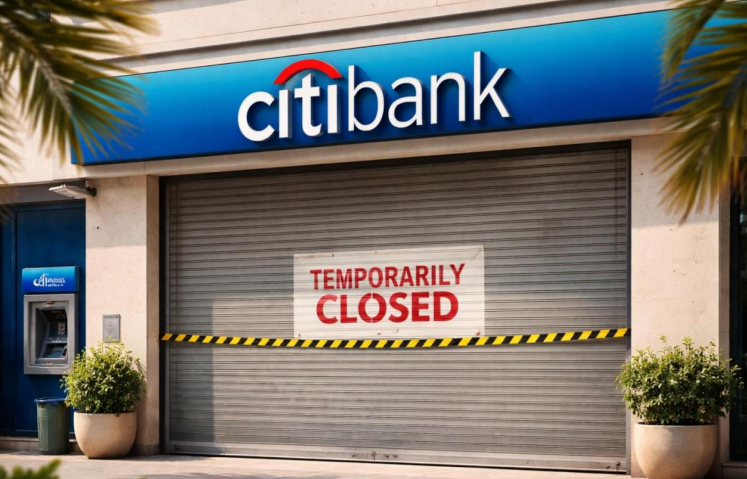
Citigroup has temporarily closed most of its banking branches and financial centers across the United Arab Emirates (UAE) as security concerns intensify across the Gulf region. The decision comes amid escalating geopolitical tensions and threats targeting financial institutions linked to Western countries operating in the region. The precautionary move reflects how global corporations and financial institutions are increasingly adjusting operations in response to rising regional instability and potential risks to infrastructure and personnel.
According to official announcements and internal communications reported by major international media outlets, Citibank branches in the UAE will remain closed from March 12 to March 14, with most services shifting to digital and remote platforms during the period. The bank has indicated that affected branches are expected to reopen on March 16, once the immediate security concerns have eased. One branch at Mall of the Emirates in Dubai has remained operational to provide limited in-person services for customers during the temporary closure period.
The temporary shutdown illustrates the ripple effects of the broader regional conflict that has heightened security alerts across the Middle East. Financial institutions, multinational corporations and consulting firms operating in major financial hubs such as Dubai and Abu Dhabi have begun implementing contingency plans to safeguard staff and maintain business continuity while minimizing risks to operations and personnel.
Security Threats Drive Banking Precautions
The decision to close branches follows growing warnings that financial institutions associated with the United States and allied countries could become potential targets amid the expanding regional crisis. Iranian officials have publicly warned that economic centers and banks linked to Western interests could face retaliation after recent military escalations in the region.
In response to these threats, major international banks have taken precautionary measures to protect employees and maintain operational stability. Citigroup evacuated several offices in the UAE and instructed many employees to shift to remote working arrangements, enabling essential banking functions to continue without exposing staff to potential risks.
Security analysts say financial institutions are particularly sensitive to such threats because banking infrastructure represents a critical component of national economic systems. Any attack on banking facilities or financial districts could disrupt financial transactions, investor confidence and cross-border capital flows, making precautionary measures essential during periods of geopolitical instability.
Regional Financial Hubs Face Heightened Risks
Dubai has emerged over the past two decades as one of the most important financial centers in the Middle East, hosting hundreds of global banks, hedge funds and asset-management firms. The Dubai International Financial Centre (DIFC) alone houses hundreds of financial institutions and multinational companies that manage billions of dollars in global investment flows.
Because of its strategic economic importance, the city has become a focal point for international financial activity connecting Europe, Asia and Africa. However, the current geopolitical tensions have raised concerns that such financial hubs could be indirectly affected by regional conflicts or targeted threats aimed at Western financial institutions operating in the Gulf.
As a result, multinational corporations and financial firms are reassessing risk management strategies across the region. Temporary closures, remote working policies and evacuation plans have become part of a broader effort to protect operations while ensuring that global financial services continue without interruption.
Banking Sector Adapts to Maintain Services
Despite the closure of most physical branches, Citibank has emphasized that banking services remain available through digital platforms, mobile banking applications and online services. Customers have been encouraged to use remote banking channels for transactions such as fund transfers, account management and payment services during the temporary closure period.
The shift toward digital banking infrastructure has allowed financial institutions to maintain operational continuity even during periods of crisis or physical disruption. Online platforms enable banks to serve clients across multiple regions without relying exclusively on branch-based services, reducing the impact of temporary closures.
However, the bank has acknowledged that certain services, including cheque processing and telephone banking, may operate at reduced capacity during the disruption. Customers have also been informed that transaction processing timelines could experience minor delays until normal operations resume.
Wider Impact Across Global Financial Institutions
Citigroup is not the only institution adjusting its operations in the Gulf region. Other multinational banks and financial organizations have also introduced precautionary measures in response to the same security concerns. HSBC has closed several branches in Qatar, while other financial firms have instructed employees to work remotely from safer locations.
Consulting and professional-services firms with large regional offices, including major global accounting firms, have similarly adopted evacuation protocols and remote working policies. These measures reflect the interconnected nature of global financial services, where disruptions in one region can quickly influence corporate strategies across multiple countries.
Financial analysts note that while the immediate operational impact may be limited due to digital banking capabilities, prolonged instability could affect investor sentiment and business activity across regional financial hubs. Dubai’s role as a secure and stable international financial center is therefore closely tied to the broader geopolitical environment.
Conclusion
The temporary closure of Citibank’s UAE branches represents a precautionary response to a rapidly evolving geopolitical situation rather than a fundamental disruption of financial operations. By shifting employees to remote work and relying on digital banking platforms, the bank has sought to maintain services while prioritizing the safety of staff and customers.
The move also highlights how global corporations and financial institutions increasingly rely on contingency planning and technological infrastructure to navigate periods of geopolitical uncertainty. As regional tensions continue to shape economic and security conditions across the Middle East, financial institutions operating in the Gulf are likely to maintain heightened vigilance while adapting operational strategies to ensure stability and continuity in global financial markets.