Social Media Ban Lifted After Deadly Protests
Nepal Gen Z protests government has lifted its controversial ban on major social media platforms—Facebook, WhatsApp, Instagram, YouTube, and X—after widespread demonstrations turned violent, leaving at least 19 people dead and more than 100 injured.
The decision came after days of escalating unrest, where citizens, particularly youth, demanded freedom of expression and greater accountability from political leaders.
While reversing the ban, authorities imposed an indefinite curfew in Kathmandu and a temporary one in Lalitpur to prevent further violence.
Prime Minister K. P. Sharma Oli, who has faced mounting criticism for the crisis, expressed sorrow over the loss of lives and announced compensation for victims’ families, free medical treatment for the injured, and the formation of a probe panel expected to deliver findings within 15 days.
However, observers note that lifting the ban may not be enough to quell public anger. Many Nepalis see the protests as a reflection of deeper frustrations over corruption, nepotism, and ineffective governance. Analysts warn that the movement could evolve into a larger political reckoning for Nepal Gen Z protests ruling elite.
Gen Z Uprising Becomes a Political Turning Point
The protests, now being widely referred to as the “Gen Z uprising,” were not only about social media restrictions. For thousands of young Nepalis, the ban became the breaking point after years of disillusionment with a political class they view as corrupt and self-serving.
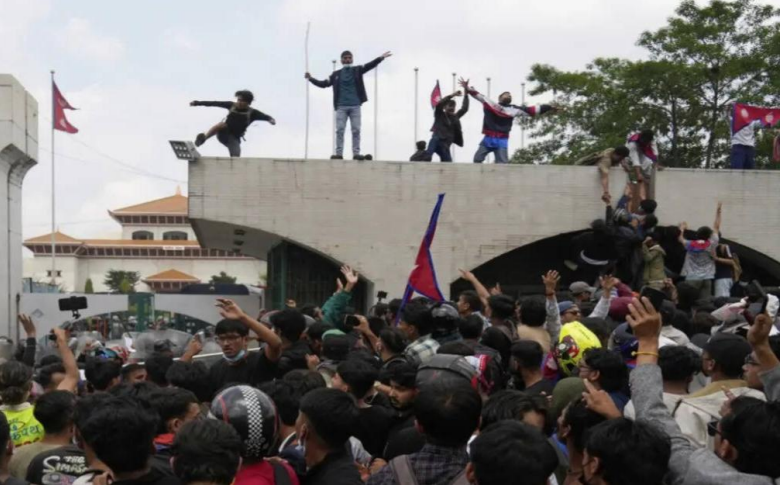
Crowds of mostly young demonstrators stormed streets in Kathmandu and other cities, torching government and political buildings. Among the properties set ablaze were the Parliament building, the President’s Office, and the headquarters of the Commission for the Investigation of Abuse of Authority (CIAA). Several homes of high-ranking politicians were also attacked.
What stands out in this movement is its symbolism. Protesters rallied under the banner of the “Straw Hat Pirates” flag from the anime One Piece. The flag, representing rebellion against corrupt authority in the series, has become the emblem of Nepal’s youth-driven movement, showcasing how digital culture and generational identity are shaping political protests in South Asia.
Oli’s Leadership Under Severe Pressure
Prime Minister Oli, already under scrutiny for his handling of corruption and governance issues, now finds himself cornered. Although he attempted to ease tensions by lifting the social media ban, the political costs remain severe.
His critics argue that Oli underestimated the anger of young citizens and overplayed his government’s authority in restricting online platforms.
Sources within political circles suggest that Oli may face mounting calls to resign or step down as protests continue to spiral. His attempt to stabilize the situation with curfews and army deployment has also raised concerns about democratic backsliding in the country.
Growing Concerns Over Democratic Freedoms
Nepal Gen Z protests has struggled with political instability for decades, transitioning from monarchy to democracy while battling corruption scandals, factionalism, and governance failures.
The Gen Z protests have exposed the fragility of the country’s democratic institutions and the growing rift between young citizens and political leaders.
For many Nepali youths, the social media ban was seen as an attack on their right to free expression and access to information. Social platforms are not only communication tools but also vital spaces for organizing, activism, and voicing frustrations.
Analysts warn that the crackdown damaged the trust between government and citizens, potentially fueling long-term instability.
Regional and Global Implications
Nepal Gen Z protests crisis is drawing international attention, particularly from neighboring India and China, which both have strong geopolitical stakes in the Himalayan nation.
The closure of border points and the deployment of the Nepal Army to secure critical infrastructure highlight the scale of disruption caused by the protests.
Human rights organizations have also raised alarms about excessive use of force, with reports of casualties and mass arrests. Calls are growing for Nepal’s government to respect citizens’ democratic rights and avoid further restrictions that could inflame tensions.
What Lies Ahead for Nepal?
The Gen Z uprising has become more than a protest against social media restrictions—it is emerging as a political movement demanding systemic change.
With curfews in place, the army deployed, and the capital city on edge, the government faces immense pressure to deliver genuine reforms rather than temporary fixes.
Analysts argue that unless political leaders address the root causes—corruption, nepotism, and lack of opportunities—the protests are unlikely to subside. Instead, they may pave the way for new political realignments, where youth-led movements could challenge the traditional dominance of Nepal’s aging political elite.
For now, Nepal stands at a critical crossroads. The lifting of the social media ban may ease one grievance, but the deeper demands for justice, transparency, and democratic accountability remain unresolved.
The next few weeks will determine whether the government can calm the streets—or whether the Gen Z uprising will reshape the nation’s political landscape for years to come.